Accounting policies and procedures manual template
A fill-in manual that records how your business keeps its books: who does what, approvals, recording rules and controls.

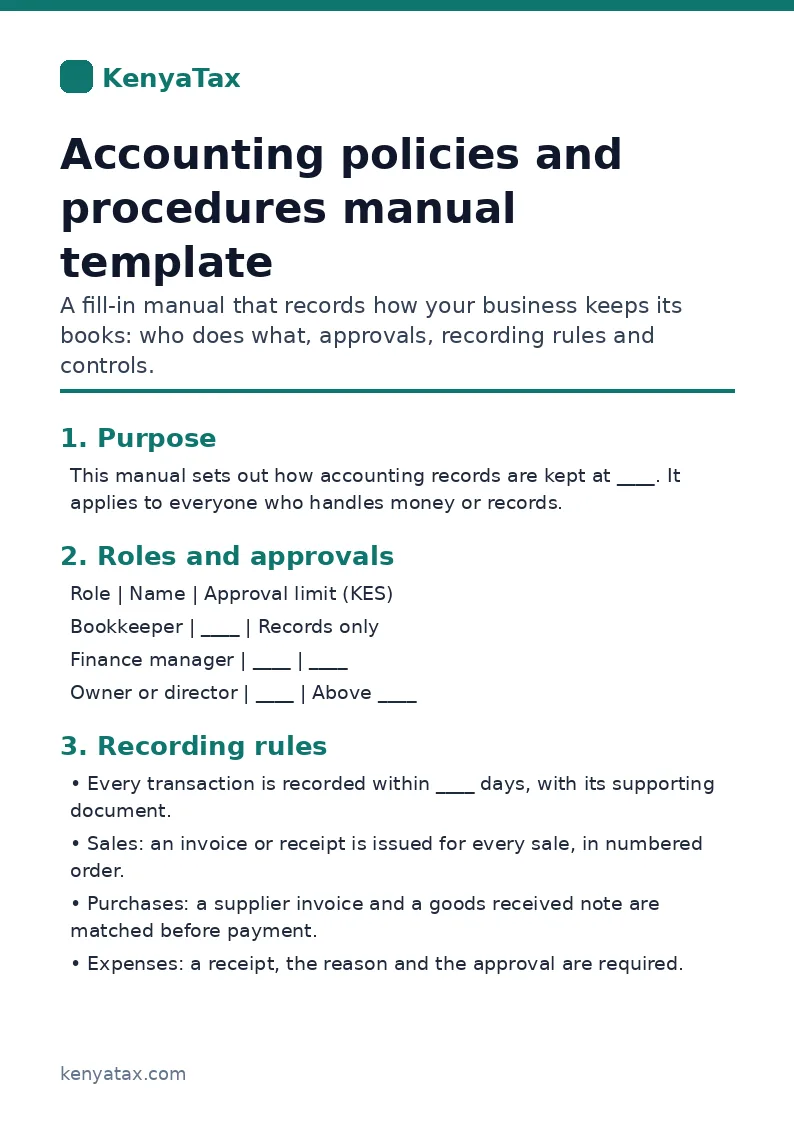
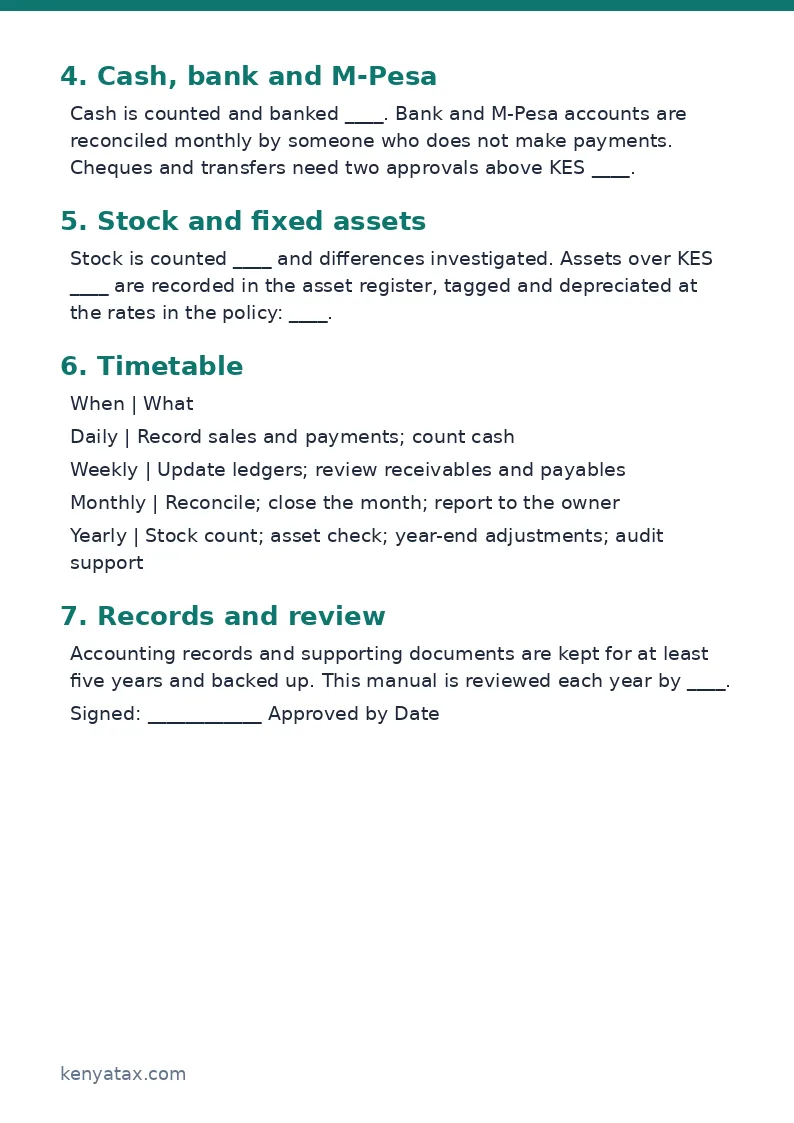
When accounting practices live in one person's head, errors and fraud are easier. This manual template writes them down: roles and approvals, how transactions are recorded, rules for receipts, payments, expenses, stock and assets, the monthly timetable, record retention and a review routine, with blanks you fill in so the manual describes your own business.
Business owners, finance managers and bookkeepers who want clear, documented accounting procedures, and growing businesses preparing for audit or funding.
What is included
- Roles and approval limits
- Recording rules for sales, purchases and expenses
- Cash, bank and M-Pesa procedures
- Month-end and year-end timetable
- Record retention and review
Advertisement
Screenshots
How to use it
- Fill in the names, limits and systems in each section.
- Change each rule to match what you actually do.
- Have the owner approve and sign the manual.
- Train staff, and review the manual once a year.
Templates are tools to help with your own records. They are not tax or legal advice. Check the figures against official sources before filing or paying.
Advertisement
More in this category
-
 Accountingpdf
Credit control policy and collection letters
A credit policy and four collection letters, from a friendly reminder to a final demand, to get paid on time.
KES 810KES 900-10%
View details →
-
 Accountingpdf
Audit preparation guide for small businesses
How to prepare for an annual audit: documents, schedules, timeline and what the auditor will ask.
KES 900KES 1,000-10%
View details →
-
 Accountingpdf
Internal controls checklist for small businesses
A practical checklist of controls that protect a small business from error and fraud: cash, sales, purchases and payroll.
KES 720KES 800-10%
View details →
What the accounting policies and procedures manual template gives you
When accounting practices live in one person's head, errors and fraud are easier. This manual template writes them down: roles and approvals, how transactions are recorded, rules for receipts, payments, expenses, stock and assets, the monthly timetable, record retention and a review routine, with blanks you fill in so the manual describes your own business.
Who it is for
Business owners, finance managers and bookkeepers who want clear, documented accounting procedures, and growing businesses preparing for audit or funding.
How to use it
- Fill in the names, limits and systems in each section.
- Change each rule to match what you actually do.
- Have the owner approve and sign the manual.
- Train staff, and review the manual once a year.
- Keep a signed or dated copy with your records, so you can show what was agreed or done.
What is inside
- Roles and approval limits
- Recording rules for sales, purchases and expenses
- Cash, bank and M-Pesa procedures
- Month-end and year-end timetable
- Record retention and review
The document is a ready-to-print PDF with these parts: 1. Purpose, 2. Roles and approvals, 3. Recording rules, 4. Cash, bank and M-Pesa, 5. Stock and fixed assets, 6. Timetable, 7. Records and review. It is laid out for A4, with the headings, tables and tick boxes already in place, so you can print it and fill it in by hand, or type into it with a PDF editor.
Tips for getting it right
- Write what you really do, then improve it.
- Separate who records from who approves.
- Set approval limits and stick to them.
- Update the manual whenever a system changes.
Why it helps
Accounting records let you answer three questions at any time: what came in, what went out and who owes whom. Kept consistently they also make tax returns, loan applications and the sale of a business much easier, because the evidence is already organised. Entering transactions the day they happen is far cheaper than reconstructing them at year end.
Questions people ask
Can I edit it? It is a PDF, so it is meant to be printed and completed, or filled with a PDF editor. If you want to change the wording, copy the text into Word or Google Docs and adapt it to your business.
Is it legal advice? No. It is a practical starting point written for Kenya. Rules change, so check the current position and ask a professional where the stakes are high.
Will it work on my phone? Yes for reading. For filling in and printing, a computer or a PDF app works best.
Keeping it safe and up to date
Good accounting records are a legal duty as well as a management tool: keep the supporting receipts and invoices with the workbook, and keep each year's copy for at least five years. Work on a copy, never on your only file, and back it up.
Read how to keep business records for KRA for the wider picture. See more accounting templates or ask us for a custom one.
This document is general information, not tax, legal or accounting advice, and it is not affiliated with the Kenya Revenue Authority. If something does not work as described, contact us and we will put it right.
Related guides, calculators and templates
- Guide: How to keep business records for KRA: what to save and for how long
- Guide: Bank reconciliation step by step: match your books to your bank
- Guide: Fixed assets and capital allowances explained for small businesses
- Another template: 13-week cash flow forecast
- Another template: Accounts payable ageing schedule
- Another template: Accounts receivable ledger (up to 1,000 invoices)
Need something different? Request a custom template, browse all guides or see every Excel template.
Scroll inside the box to read more.