Capital gains computation sheet
Work out the gain on each asset you sell after costs and improvements, and the capital gains tax at the current rate.

Capital gains tax is charged on the gain, not on the sale price. This sheet takes each disposal with its date, sale price, cost, improvements and selling costs, works out the gain, applies the capital gains tax rate and totals the tax, so you can see what a sale will really leave you with.
People selling land, buildings or shares, and the accountants and lawyers who advise them, who want a quick, transparent computation before they agree a price.
What is included
- Gain worked out after costs and improvements
- Tax at the rate on the Rates sheet
- Loss shown as zero tax
- Net proceeds after tax
- Totals for several disposals
Advertisement
Screenshots
How to use it
- Check the capital gains tax rate on the Rates sheet.
- Enter each asset with its dates, sale price and cost.
- Add improvement costs and selling costs such as legal fees and agent commission.
- Read the gain and the tax for each asset and in total.
Templates are tools to help with your own records. They are not tax or legal advice. Check the figures against official sources before filing or paying.
Advertisement
More in this category
-
 Taxpdf
Tax audit survival guide
What to do when KRA announces an audit: the types, your rights, the documents to prepare and how to respond.
KES 1,080KES 1,200-10%
View details →
-
 Taxpdf
Rental income tax guide for landlords
Monthly rental tax or annual return? How landlords register, file, pay and keep records, with a worked example.
KES 720KES 800-10%
View details →
-
 Taxpdf
Withholding tax guide for Kenyan businesses
Who must withhold tax, on which payments, at what rates, and how to remit, issue certificates and keep records.
KES 720KES 800-10%
View details →
What the capital gains computation sheet does
Capital gains tax is charged on the gain, not on the sale price. This sheet takes each disposal with its date, sale price, cost, improvements and selling costs, works out the gain, applies the capital gains tax rate and totals the tax, so you can see what a sale will really leave you with.
Who it is for
People selling land, buildings or shares, and the accountants and lawyers who advise them, who want a quick, transparent computation before they agree a price.
How to use the workbook
- Check the capital gains tax rate on the Rates sheet.
- Enter each asset with its dates, sale price and cost.
- Add improvement costs and selling costs such as legal fees and agent commission.
- Read the gain and the tax for each asset and in total.
- Save a copy under a new name for each month or year, so earlier records stay as they were.
What is inside
- Gain worked out after costs and improvements
- Tax at the rate on the Rates sheet
- Loss shown as zero tax
- Net proceeds after tax
- Totals for several disposals
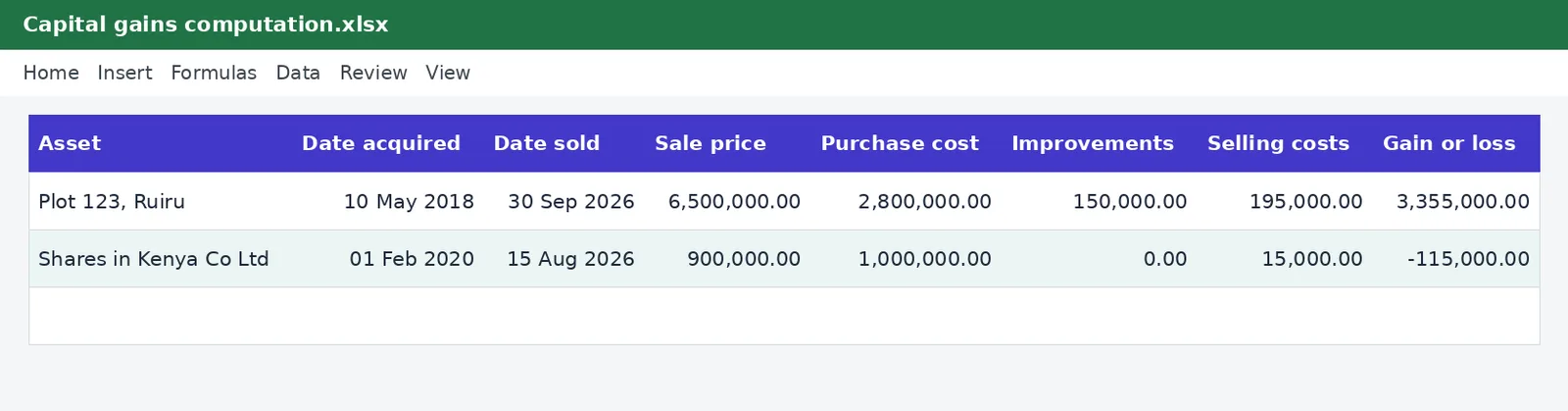
The workbook has these sheets: Instructions, Gains, Rates. The main table has the columns Asset; Date acquired; Date sold; Sale price; Purchase cost; Improvements; Selling costs; Gain or loss. Yellow cells are for you to fill in and grey cells calculate by themselves, so leave the grey cells alone. The example rows show how it works; type over them with your own entries.
Tips for getting it right
- Keep the sale agreement, the original purchase documents and receipts for improvements.
- Check which costs are allowable for your type of asset.
- File and pay the tax within the time allowed after the transfer.
- Use the capital gains tax calculator on the site to cross-check.
Why keep this record
Most tax trouble comes from late or missing records rather than from the tax itself. When the figures are collected as they happen, preparing a return becomes a matter of copying totals, not of searching for receipts. A workbook that follows the same layout as the return also makes it easier to spot a number that looks wrong before KRA does, and to explain it if asked.
Questions people ask
Do I need to know Excel formulas? No. Type into the yellow cells and the rest is worked out for you. The formulas are visible if you want to see how a figure is reached.
Can I add rows or change the layout? You can add your own columns to the right and your own notes. If you insert rows inside a table, copy the grey formula cells down so the new rows calculate too.
Will it work on my phone or in Google Sheets? Yes for viewing and typing, but dropdown lists and the charts look best in desktop Excel or LibreOffice.
Keeping it safe and up to date
Tax figures change with each Finance Act, so check the Rates sheet against KRA's current guidance before you file. Keep the supporting documents with the workbook, and keep each year's copy for at least five years in case KRA asks for proof.
Read the KRA filing calendar for small businesses for the wider picture. Free calculators that go with it: Capital gains tax calculator. See more tax templates or ask us for a custom one.
The workbook works in Microsoft Excel, LibreOffice and Google Sheets. It is a tool to help you work out and record figures, not tax, legal or accounting advice, and it is not affiliated with the Kenya Revenue Authority. If something does not work as described, contact us and we will put it right.
Related guides, calculators and templates
- Free calculator: Capital Gains Tax Calculator
- Guide: Monthly rental income tax or annual tax: which route is better for a landlord?
- Guide: The KRA filing calendar for small businesses: every monthly and yearly deadline
- Guide: KRA penalties and interest explained: what late filing and payment cost
- Another template: Annual income tax estimator
- Another template: Corporation tax computation workbook
- Another template: Freelancer turnover tax versus annual tax comparison
Need something different? Request a custom template, browse all guides or see every Excel template.
Scroll inside the box to read more.