Annual income tax estimator
Estimate your income tax for the year from all your income, with deductions and reliefs, and see whether you owe more or are due a refund.

Pull together your employment, rental, business and other income, subtract your allowable deductions, and see the estimated tax for the year after personal relief and what you have already paid. A positive balance means you may owe more; a negative one means a possible refund.
What is included
- All income sources in one place
- Tax bands and personal relief applied
- Balance after tax already paid
Advertisement
Screenshots
How to use it
- Check the bands on the Rates sheet.
- Enter your income, deductions and tax paid.
- Read the balance.
Rates and thresholds
Edit the bands and reliefs on the Rates sheet.
Templates are tools to help with your own records. They are not tax or legal advice. Check the figures against official sources before filing or paying.
Advertisement
More in this category
-
 Taxpdf
Tax audit survival guide
What to do when KRA announces an audit: the types, your rights, the documents to prepare and how to respond.
KES 1,080KES 1,200-10%
View details →
-
 Taxpdf
Rental income tax guide for landlords
Monthly rental tax or annual return? How landlords register, file, pay and keep records, with a worked example.
KES 720KES 800-10%
View details →
-
 Taxpdf
Withholding tax guide for Kenyan businesses
Who must withhold tax, on which payments, at what rates, and how to remit, issue certificates and keep records.
KES 720KES 800-10%
View details →
Know roughly what you owe before the 30 June deadline
Every year, millions of Kenyans file an income tax return, and many of them are surprised by the result. They had PAYE deducted at work, so they assume everything is settled, but they also earned rent, ran a side business or received other income that was not taxed at source. The return brings all of it together, and the result can be a bill, a refund, or nothing. This estimator lets you see where you stand before you file. You enter your income and deductions for the year and it shows an estimate of the tax, the reliefs, what you have already paid, and the balance.
How the estimate is built
The workbook follows the same steps as the return. First it adds your income from employment, rent, business and other sources. Then it subtracts the deductions you are allowed, such as pension contributions to NSSF and other approved schemes, and SHIF and Housing Levy payments. The result is your taxable income. The tax bands, which are set out monthly on the Rates sheet and multiplied by twelve for the year, are applied to that, then personal relief is taken off the tax. Personal relief is currently KES 2,400 a month, which is the same amount multiplied by twelve for the year. Finally, the tax you have already paid, through PAYE, monthly rental income tax or withholding tax, is subtracted, leaving a balance. A positive balance means you may still owe tax. A negative one means you may be due a refund.
- Employment income, including taxable benefits, from your P9 form
- Rental and business income, after the allowable costs where those apply
- Allowable deductions and reliefs
- Tax already paid during the year
Filling it in step by step
- Check the bands and reliefs on the Rates sheet against the official figures.
- Take the totals from your P9 form for employment income and PAYE paid. Our guide to the P9 and the employment return shows where to find them.
- Add any rental income, business profit or other income.
- Enter your allowable deductions and any reliefs beyond personal relief.
- Enter the tax you have already paid and read the balance.
An example
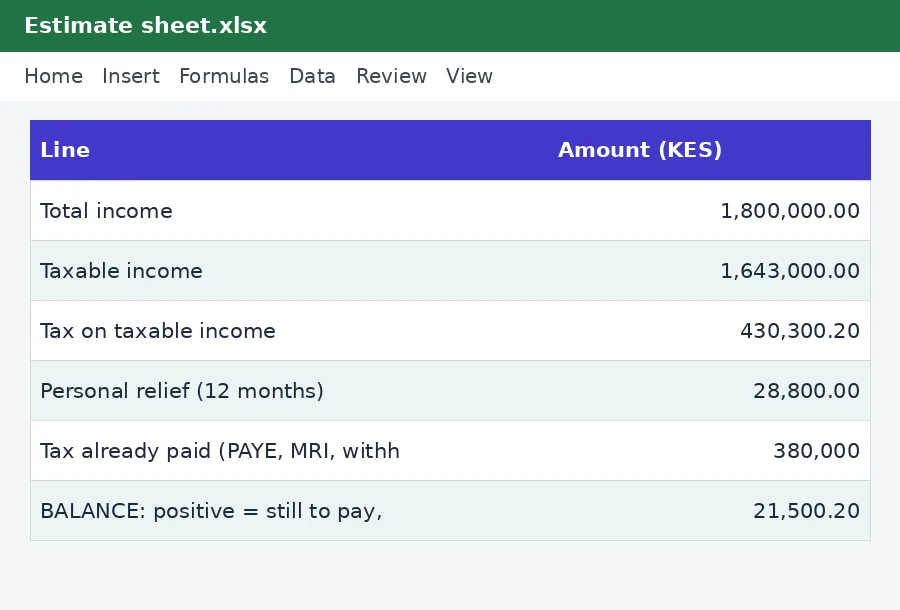
Suppose you earned KES 1,800,000 in employment income, with KES 72,000 in pension deductions and KES 85,000 in SHIF and Housing Levy payments. Taxable income is KES 1,643,000. The workbook applies the bands to that figure, takes off personal relief for the twelve months, and subtracts the KES 380,000 you have already paid through PAYE to leave the balance. Every step has its own line, so you can see where the number comes from. The example numbers in the file show this. Replace them with yours.
Why the answer can differ from your payslips
PAYE is calculated month by month, and it does not always match the annual figure exactly. Bonuses, a change of job part-way through the year, income from a second job and benefits in kind can leave you with a small balance either way. Other income that has no PAYE at all, like consulting fees or rent on the annual basis, is the most common reason a balance is owing. If you earned any of that, make sure you include it.
Deadlines and what to do next
Individual returns are generally due by 30 June after the end of the year. Our guide to the 30 June tax deadline explains who must file and what happens if you do not, and the annual tax return estimator and PAYE calculator are useful for checking pieces of the estimate. If your estimate shows tax to pay, it is due by the filing date. If you are not required to file but expect a refund, you can still claim it through a return.
Treat it as an estimate
This workbook is an estimate to help you plan, not a tax return and not tax advice. Your actual liability depends on your complete circumstances, including reliefs and rules not included here. The bands and reliefs on its Rates sheet come from the KenyaTax rates table and have not yet been verified for the period. Confirm them with the Kenya Revenue Authority, and speak to a tax adviser if your affairs are complicated.
Related guides, calculators and templates
- Free calculator: Annual Tax Return Estimator (P9)
- Free calculator: PAYE Calculator
- Guide: NSSF contributions explained: tiers, limits and what you pay
- Guide: SHIF contributions explained: rate, minimum and who pays
- Guide: Tax for freelancers and content creators in Kenya: Upwork, YouTube and TikTok income
- Another template: Instalment tax planner
- Another template: KRA filing and payment calendar
- Another template: MRI versus annual rental tax comparison
Need something different? Request a custom template, browse all guides or see every Excel template.
Scroll inside the box to read more.