Year-on-year financial comparison workbook
Compare each line of your accounts with last year, see the change in amount and percentage, and flag big movements.

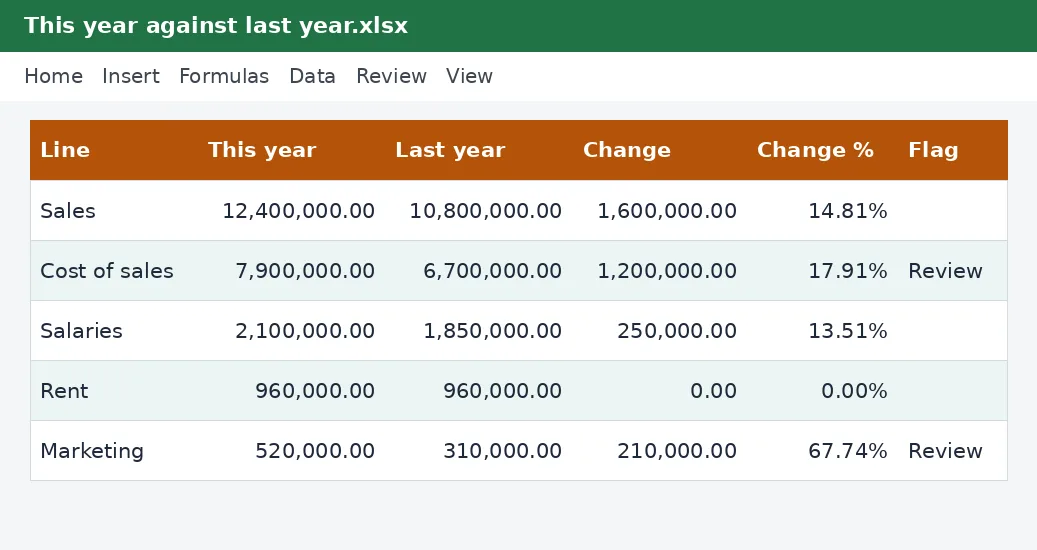
A figure means more when you can compare it. List each line of the profit and loss or balance sheet with this year's and last year's amount, and the workbook shows the change, the percentage change and flags every line that has moved by more than the percentage you set, so you know where to look and what to explain to the owner, the bank or the auditor.
Accountants, finance managers and owners who review annual accounts and prepare explanations for management, lenders or auditors.
What is included
- This year, last year and the change for every line
- Percentage change worked out
- Review flag for large movements
- Flag threshold you can set
- Count of lines to review at the top
Advertisement
Screenshots
How to use it
- Type the percentage change above which a line should be flagged.
- List each line with this year's and last year's amount.
- Read the change and the flag.
- Write an explanation for every line marked Review.
Templates are tools to help with your own records. They are not tax or legal advice. Check the figures against official sources before filing or paying.
Advertisement
More in this category
-
 Accountingpdf
Credit control policy and collection letters
A credit policy and four collection letters, from a friendly reminder to a final demand, to get paid on time.
KES 810KES 900-10%
View details →
-
 Accountingpdf
Audit preparation guide for small businesses
How to prepare for an annual audit: documents, schedules, timeline and what the auditor will ask.
KES 900KES 1,000-10%
View details →
-
 Accountingpdf
Internal controls checklist for small businesses
A practical checklist of controls that protect a small business from error and fraud: cash, sales, purchases and payroll.
KES 720KES 800-10%
View details →
What the year-on-year financial comparison workbook does
A figure means more when you can compare it. List each line of the profit and loss or balance sheet with this year's and last year's amount, and the workbook shows the change, the percentage change and flags every line that has moved by more than the percentage you set, so you know where to look and what to explain to the owner, the bank or the auditor.
Who it is for
Accountants, finance managers and owners who review annual accounts and prepare explanations for management, lenders or auditors.
How to use the workbook
- Type the percentage change above which a line should be flagged.
- List each line with this year's and last year's amount.
- Read the change and the flag.
- Write an explanation for every line marked Review.
- Save a copy under a new name for each month or year, so earlier records stay as they were.
What is inside
- This year, last year and the change for every line
- Percentage change worked out
- Review flag for large movements
- Flag threshold you can set
- Count of lines to review at the top
The workbook has these sheets: Instructions, Comparison. The main table has the columns Line; This year; Last year; Change; Change %; Flag. Yellow cells are for you to fill in and grey cells calculate by themselves, so leave the grey cells alone. The example rows show how it works; type over them with your own entries.
Tips for getting it right
- Use the same grouping of accounts in both years.
- Adjust last year's figures if the classification changed.
- Explain movements in writing, with the cause and the evidence.
- Review the large lines first.
Why keep this record
Accounting records let you answer three questions at any time: what came in, what went out and who owes whom. Kept consistently they also make tax returns, loan applications and the sale of a business much easier, because the evidence is already organised. Entering transactions the day they happen is far cheaper than reconstructing them at year end.
Questions people ask
Do I need to know Excel formulas? No. Type into the yellow cells and the rest is worked out for you. The formulas are visible if you want to see how a figure is reached.
Can I add rows or change the layout? You can add your own columns to the right and your own notes. If you insert rows inside a table, copy the grey formula cells down so the new rows calculate too.
Will it work on my phone or in Google Sheets? Yes for viewing and typing, but dropdown lists and the charts look best in desktop Excel or LibreOffice.
Keeping it safe and up to date
Good accounting records are a legal duty as well as a management tool: keep the supporting receipts and invoices with the workbook, and keep each year's copy for at least five years. Work on a copy, never on your only file, and back it up.
Read how to keep business records for KRA for the wider picture. Free calculators that go with it: Corporation tax calculator. See more accounting templates or ask us for a custom one.
The workbook works in Microsoft Excel, LibreOffice and Google Sheets. It is a tool to help you work out and record figures, not tax, legal or accounting advice, and it is not affiliated with the Kenya Revenue Authority. If something does not work as described, contact us and we will put it right.
Related guides, calculators and templates
- Free calculator: Corporation Tax Calculator
- Guide: How to choose accounting software for a small business
- Guide: How to run a month-end close for a small business
- Guide: How to read a balance sheet: a guide for small business owners in Kenya
- Another template: Audit preparation guide for small businesses
- Another template: Branch and department profit and loss
- Another template: Financial statements explained for business owners
Need something different? Request a custom template, browse all guides or see every Excel template.
Scroll inside the box to read more.