Employment contract template for Kenya
A plain-English employment contract with every clause an employer needs: pay, hours, leave, notice and termination.

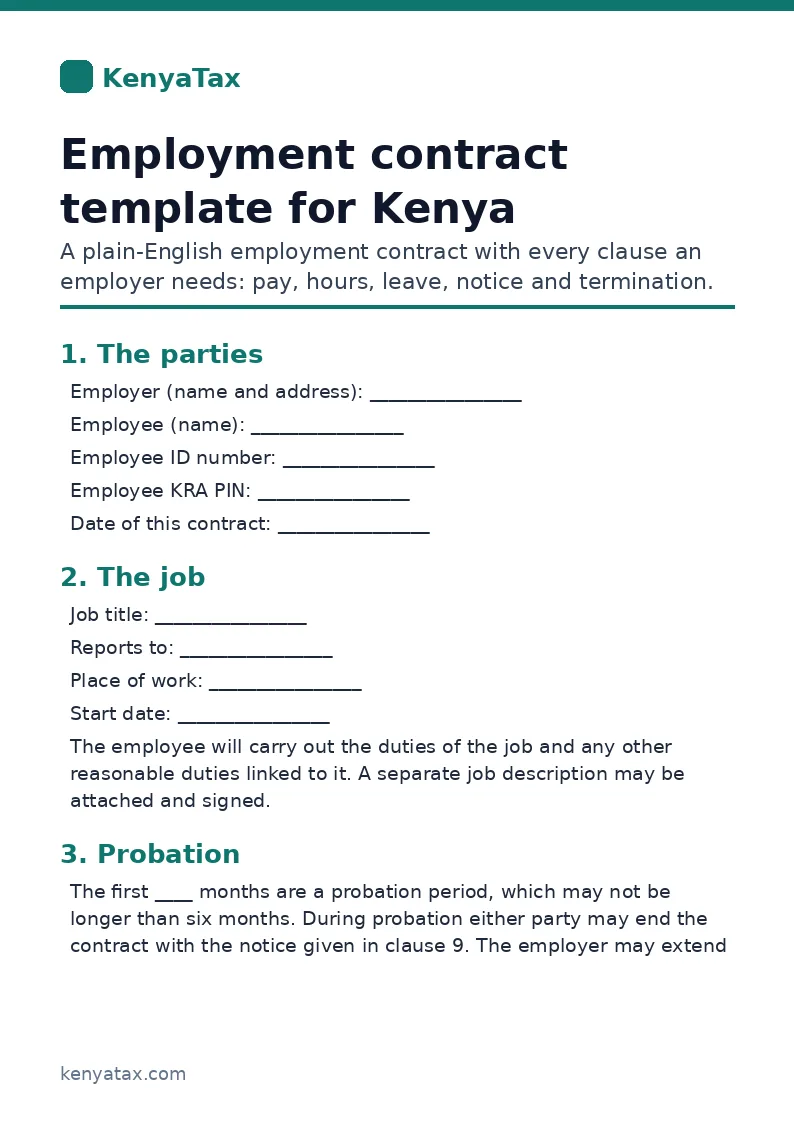
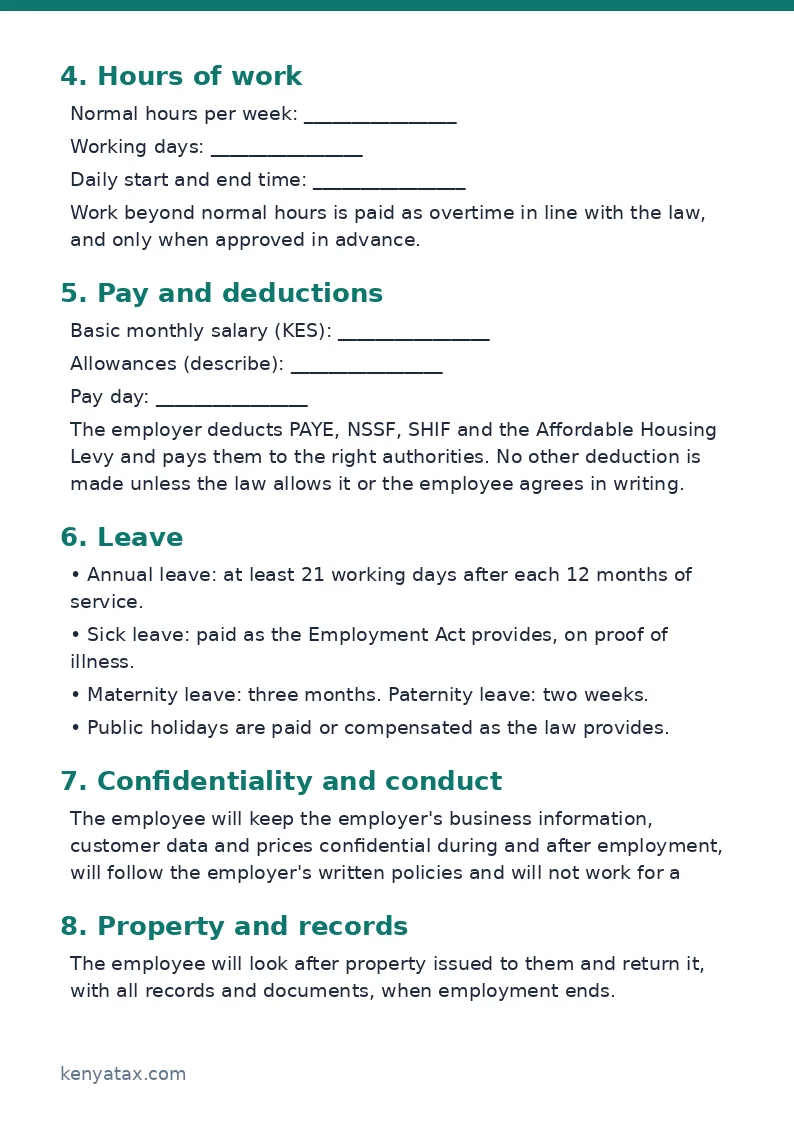
The Employment Act expects most employment to be recorded in writing, and a clear contract prevents most disputes. This template sets out an employment contract clause by clause, with fill-in fields, notes on what each clause must contain and plain wording an employee can understand, ready to print, complete and sign.
Small employers, HR officers and startups hiring their first staff, and employees who want to see what a fair contract contains.
What is included
- Fill-in fields for parties, job, pay and hours
- Clauses for probation, leave and sickness
- Notice and termination clauses
- Confidentiality and conduct
- Signature page for both parties
Advertisement
Screenshots
How to use it
- Fill in the parties and the job details.
- Read each clause and adjust the wording to fit your business.
- Check the pay, leave and notice clauses against the Employment Act.
- Have both parties sign and keep a copy each.
Templates are tools to help with your own records. They are not tax or legal advice. Check the figures against official sources before filing or paying.
Advertisement
More in this category
-
 Payrollpdf
Payroll policy and procedures manual
A written payroll manual: roles, monthly timetable, calculations, approvals, payment, remittances and record keeping.
KES 1,080KES 1,200-10%
View details →
-
 Payrollpdf
Leave policy template for Kenyan employers
A complete leave policy covering annual, sick, maternity, paternity, compassionate and study leave, with how to apply.
KES 540KES 600-10%
View details →
-
 Payrollpdf
Termination and redundancy guide with letters
How to end employment lawfully in Kenya: notice, final dues, redundancy steps and the letters you will need.
KES 900KES 1,000-10%
View details →
What the employment contract template for kenya gives you
The Employment Act expects most employment to be recorded in writing, and a clear contract prevents most disputes. This template sets out an employment contract clause by clause, with fill-in fields, notes on what each clause must contain and plain wording an employee can understand, ready to print, complete and sign.
Who it is for
Small employers, HR officers and startups hiring their first staff, and employees who want to see what a fair contract contains.
How to use it
- Fill in the parties and the job details.
- Read each clause and adjust the wording to fit your business.
- Check the pay, leave and notice clauses against the Employment Act.
- Have both parties sign and keep a copy each.
- Keep a signed or dated copy with your records, so you can show what was agreed or done.
What is inside
- Fill-in fields for parties, job, pay and hours
- Clauses for probation, leave and sickness
- Notice and termination clauses
- Confidentiality and conduct
- Signature page for both parties
The document is a ready-to-print PDF with these parts: 1. The parties, 2. The job, 3. Probation, 4. Hours of work, 5. Pay and deductions, 6. Leave, 7. Confidentiality and conduct, 8. Property and records, 9. Notice and termination, 10. Agreement. It is laid out for A4, with the headings, tables and tick boxes already in place, so you can print it and fill it in by hand, or type into it with a PDF editor.
Tips for getting it right
- Give the employee time to read it before signing.
- Keep the signed original and give a copy to the employee.
- Never offer less than the law gives; the law overrides the contract.
- Record any later change in a signed letter.
Why it helps
Staff records go wrong in small, repeated ways: a figure typed twice, a deadline forgotten, a promise that nobody wrote down. A tidy workbook that everyone uses the same way removes most of those problems. It also gives you something to show an employee, an auditor or a labour officer when a question comes up months later, and it makes the next payroll quicker because the facts are already in one place.
Questions people ask
Can I edit it? It is a PDF, so it is meant to be printed and completed, or filled with a PDF editor. If you want to change the wording, copy the text into Word or Google Docs and adapt it to your business.
Is it legal advice? No. It is a practical starting point written for Kenya. Rules change, so check the current position and ask a professional where the stakes are high.
Will it work on my phone? Yes for reading. For filling in and printing, a computer or a PDF app works best.
Keeping it safe and up to date
Payroll records are personal data and tax records at once, so keep the file somewhere only the people who need it can open, and keep each month's copy for at least five years. Statutory rates such as NSSF limits and the Housing Levy change, so check the Rates sheet against the official source before you rely on a figure.
Read how to run payroll for a small business for the wider picture. Free calculators that go with it: Paye calculator. See more payroll templates or ask us for a custom one.
This document is general information, not tax, legal or accounting advice, and it is not affiliated with the Kenya Revenue Authority. If something does not work as described, contact us and we will put it right.
Related guides, calculators and templates
- Free calculator: PAYE Calculator
- Guide: How to prepare for a performance review and a salary talk
- Guide: Caretakers and property managers: roles, pay and oversight
- Guide: How KRA uses data matching and what it means for you
- Another template: Annual PAYE and payroll summary
- Another template: Benefits and allowances register
- Another template: Bonus and 13th month planner
Need something different? Request a custom template, browse all guides or see every Excel template.
Scroll inside the box to read more.