SOP writing guide and templates
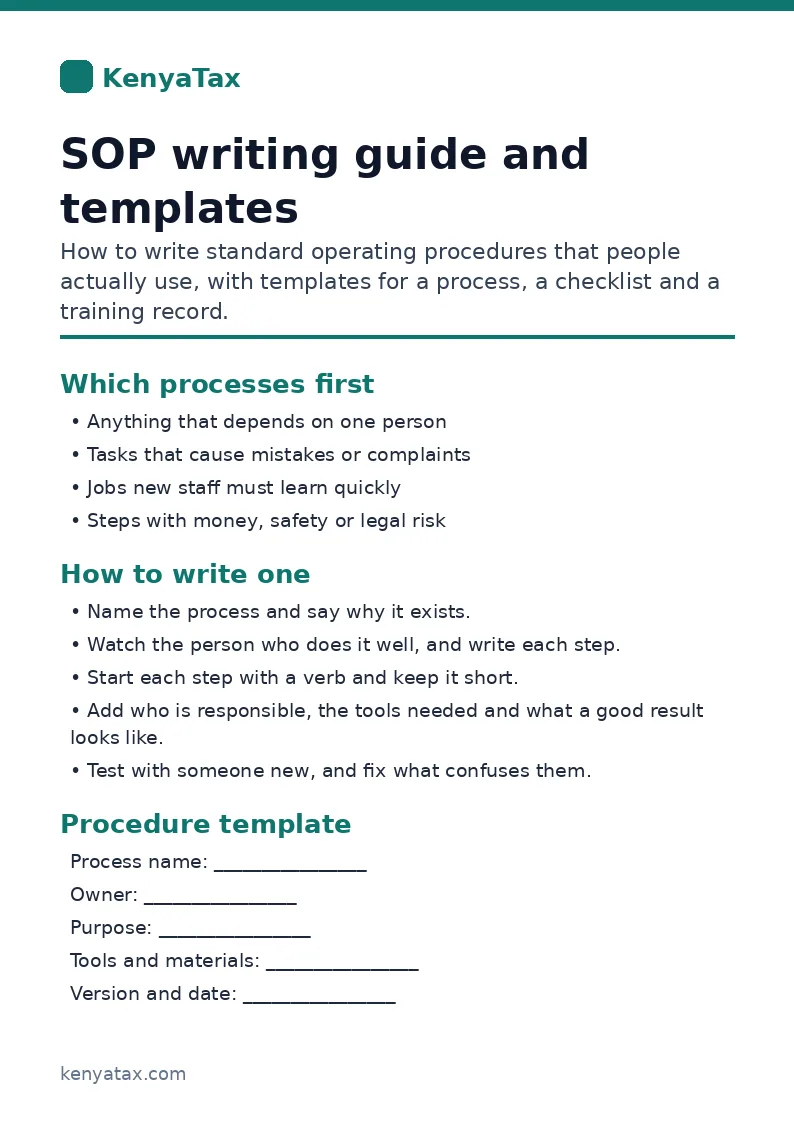
How to write standard operating procedures that people actually use, with templates for a process, a checklist and a training record.

When only one person knows how a job is done, the business is fragile. This guide shows how to write standard operating procedures that people use: choosing which processes to write first, interviewing the person who does the work, writing clear numbered steps, testing the procedure and keeping it current, with templates for a procedure, a checklist and a training record.
Business owners and managers who want consistent work, easier training and a business that does not depend on one person.
What is included
- How to choose and write an SOP
- Procedure template
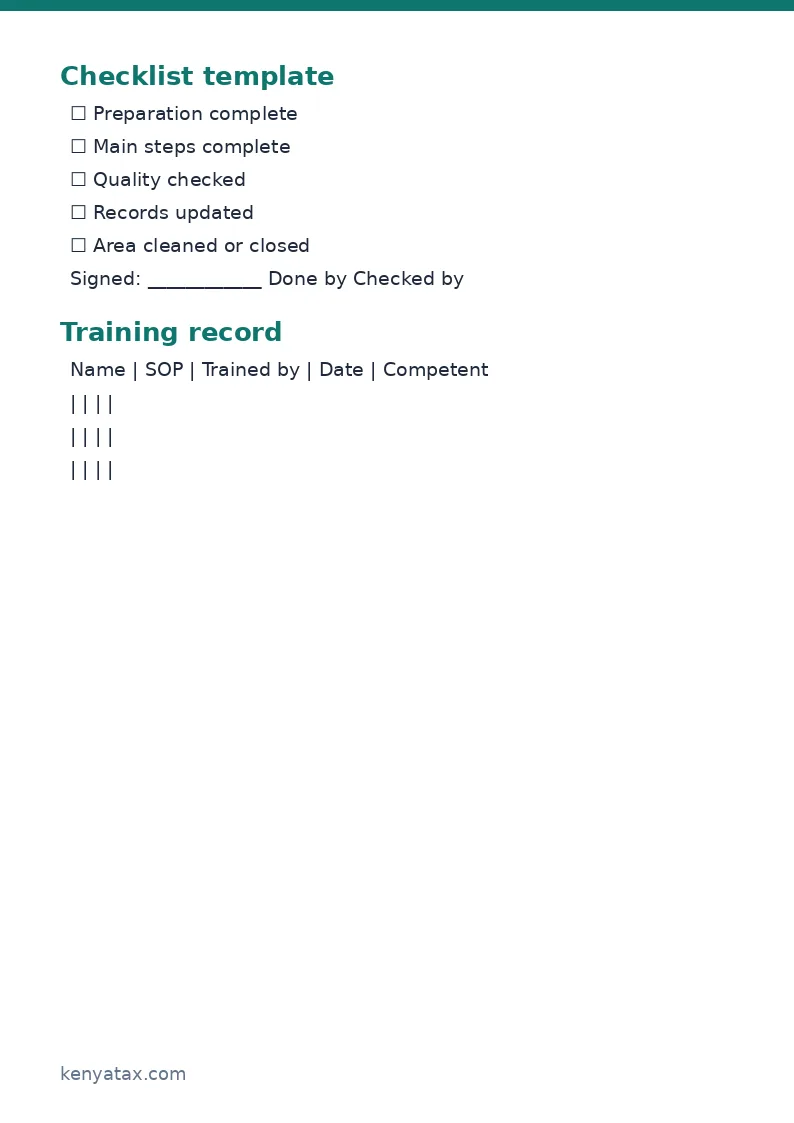
- Checklist template
- Training record
- Review log
Advertisement
Screenshots
How to use it
- Choose the three processes that cause the most trouble or depend on one person.
- Watch the work and write the steps in the template.
- Ask someone new to follow the SOP and fix what confuses them.
- Store the SOPs where everyone can find them and review them yearly.
Templates are tools to help with your own records. They are not tax or legal advice. Check the figures against official sources before filing or paying.
Advertisement
More in this category
-
 Businesspdf
Small business funding guide for Kenya
The main ways Kenyan small businesses raise money: savings, loans, SACCOs, mobile lenders, grants and investors.
KES 720KES 800-10%
View details →
-
 Businesspdf
Sales proposal and quotation pack
Win more work with a clear proposal, a professional quotation and a follow-up letter, with a checklist for each step.
KES 630KES 700-10%
View details →
-
 Businesspdf
Supplier agreement template
A plain supply agreement: goods, price, delivery, quality, payment, termination and confidentiality.
KES 810KES 900-10%
View details →
What the sop writing guide and templates gives you
When only one person knows how a job is done, the business is fragile. This guide shows how to write standard operating procedures that people use: choosing which processes to write first, interviewing the person who does the work, writing clear numbered steps, testing the procedure and keeping it current, with templates for a procedure, a checklist and a training record.
Who it is for
Business owners and managers who want consistent work, easier training and a business that does not depend on one person.
How to use it
- Choose the three processes that cause the most trouble or depend on one person.
- Watch the work and write the steps in the template.
- Ask someone new to follow the SOP and fix what confuses them.
- Store the SOPs where everyone can find them and review them yearly.
- Keep a signed or dated copy with your records, so you can show what was agreed or done.
What is inside
- How to choose and write an SOP
- Procedure template
- Checklist template
- Training record
- Review log
The document is a ready-to-print PDF with these parts: Which processes first, How to write one, Procedure template, Checklist template, Training record. It is laid out for A4, with the headings, tables and tick boxes already in place, so you can print it and fill it in by hand, or type into it with a PDF editor.
Tips for getting it right
- Write steps in the order they are done.
- Start each step with a verb.
- Use pictures and examples where they help.
- A procedure nobody tests is only a guess.
Why it helps
Running a business on memory works until it grows. Writing the numbers down turns opinions into facts you can compare month to month, and shows early which products, customers or costs deserve attention. Even a simple workbook, used every week, usually beats a sophisticated one that is opened once a year.
Questions people ask
Can I edit it? It is a PDF, so it is meant to be printed and completed, or filled with a PDF editor. If you want to change the wording, copy the text into Word or Google Docs and adapt it to your business.
Is it legal advice? No. It is a practical starting point written for Kenya. Rules change, so check the current position and ask a professional where the stakes are high.
Will it work on my phone? Yes for reading. For filling in and printing, a computer or a PDF app works best.
Keeping it safe and up to date
A plan is only as good as the numbers you put in. Start with honest estimates, update the workbook as real figures arrive, and compare the two so your next estimate is better. Save a dated copy each month so you can see how your thinking changed.
Read how to build a cash flow forecast for the wider picture. See more business templates or ask us for a custom one.
This document is general information, not tax, legal or accounting advice, and it is not affiliated with the Kenya Revenue Authority. If something does not work as described, contact us and we will put it right.
Related guides, calculators and templates
- Guide: How to build a 12-month cash flow forecast for a small business
- Guide: How to price your products and services: markup, margin and break-even
- Guide: Turnover tax for small businesses in Kenya: rate, limits and when to use it
- Another template: 12-month cash flow forecast
- Another template: Annual operating budget by department
- Another template: Break-even and pricing calculator
Need something different? Request a custom template, browse all guides or see every Excel template.
Scroll inside the box to read more.