Break-even and pricing calculator
Find how many units you must sell to cover your costs and what price gives you your target profit.

Enter your fixed costs, the cost of one unit and your price. See your break-even point, your margin, how many units you need for a target profit and a table of profit at different volumes.
What is included
- Break-even units and sales value
- Margin per unit
- Units and price needed for a profit target
- Profit table at different volumes
Advertisement
Screenshots
How to use it
- Enter your fixed costs, unit cost and price.
- Read the break-even point.
- Try other prices.
Templates are tools to help with your own records. They are not tax or legal advice. Check the figures against official sources before filing or paying.
Advertisement
More in this category
-
 Businesspdf
Small business funding guide for Kenya
The main ways Kenyan small businesses raise money: savings, loans, SACCOs, mobile lenders, grants and investors.
KES 720KES 800-10%
View details →
-
 Businesspdf
SOP writing guide and templates
How to write standard operating procedures that people actually use, with templates for a process, a checklist and a training record.
KES 810KES 900-10%
View details →
-
 Businesspdf
Sales proposal and quotation pack
Win more work with a clear proposal, a professional quotation and a follow-up letter, with a checklist for each step.
KES 630KES 700-10%
View details →
How many do you need to sell, and at what price?
Two questions decide whether most small businesses survive. First: how much do we have to sell each month just to cover our costs? Second: what price should we charge to make the profit we want? Both can be answered with a few numbers and some simple arithmetic, and this free workbook does the arithmetic. You enter your monthly fixed costs, the cost of one unit and your selling price, and it shows your break-even point, your margin, the sales you need for a target profit, and a table of profit at different volumes.
Fixed costs, variable costs and the margin between them
Costs come in two kinds. Fixed costs stay the same however much you sell: rent, salaries, insurance, subscriptions, loan repayments. Variable costs rise with every unit you sell: the stock you buy, the materials you use, the packaging, the transaction fees. The difference between your selling price and the variable cost of one unit is your contribution. It is what each sale contributes towards covering your fixed costs, and once the fixed costs are covered, towards profit.
- Contribution per unit = selling price minus variable cost per unit.
- Break-even units = fixed costs divided by the contribution per unit.
- Break-even sales = break-even units multiplied by the price.
Using the calculator
- Enter your monthly fixed costs, for example KES 85,000 for rent, salaries and subscriptions.
- Enter the variable cost of one unit, say KES 320 for the stock and packaging.
- Enter your selling price per unit before VAT, say KES 650.
- Enter the profit you want each month.
- Read the results: profit per unit, margin, break-even units, break-even sales, and the units needed for your target profit.
Reading the example
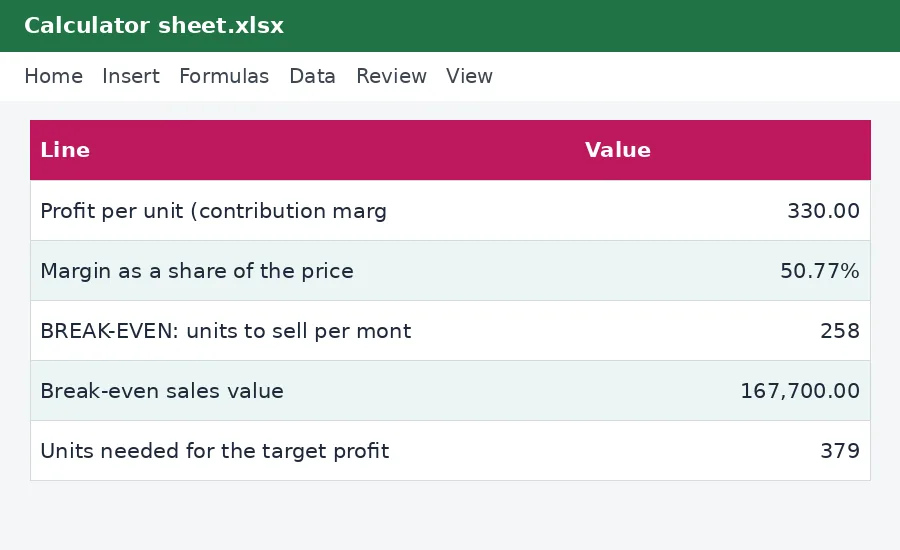
With the example figures, each unit contributes KES 330, which is a margin of about 51% of the price. Dividing KES 85,000 of fixed costs by KES 330 gives a break-even point of 258 units a month. To make a target profit of KES 40,000 the business needs about 379 units. The profit table underneath shows the profit or loss at ten different sales volumes, with losses in red, so you can see how quickly the business moves from loss to profit once it passes break-even.
Testing prices
The most useful thing to do with this workbook is to change the price and watch what happens. A small increase in price raises the contribution per unit and lowers the break-even point sharply, because the improvement applies to every unit you sell. A discount does the opposite: a price cut of 10% might require a much larger rise in volume to keep the same profit. The workbook also shows the price you would need to charge to reach your target profit at a given sales volume, which is a good check when you plan a new product.
Do not forget tax and VAT
For a clean calculation, use prices and costs before VAT, since VAT is collected for the government and is not your income. Remember, though, that your profit is also subject to tax. If you pay turnover tax, a percentage of sales goes to KRA whatever your profit, which you can include as part of your variable cost. If you pay tax on profit, your target profit should be understood as profit before tax. The turnover tax calculator and the VAT calculator are useful companions.
Limits of the model
Break-even analysis assumes your costs and prices stay constant across the volumes you test, and that you sell everything you buy. Real businesses have discounts for bulk, costs that jump when you hire, and stock that does not sell. Use the calculator as a guide for decisions, not a prediction. For businesses with many products, calculate each one separately or use an average.
This workbook is a planning aid and not financial, tax or legal advice. For tax matters, see the Kenya Revenue Authority, and speak to an accountant before committing to a major investment.
Related guides, calculators and templates
- Guide: How to build a 12-month cash flow forecast for a small business
- Guide: How to price your products and services: markup, margin and break-even
- Guide: Turnover tax for small businesses in Kenya: rate, limits and when to use it
- Another template: 12-month cash flow forecast
- Another template: Budget versus actual tracker
- Another template: Inventory and stock tracker with reorder alerts
Need something different? Request a custom template, browse all guides or see every Excel template.
Scroll inside the box to read more.