12-month cash flow forecast
Plan twelve months of money in and out and spot a cash shortfall before it happens.

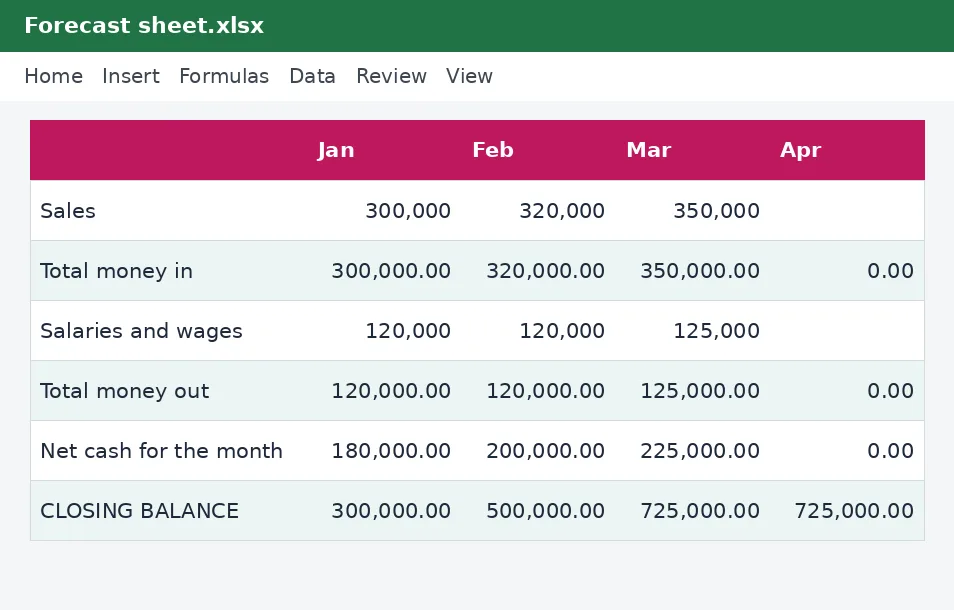
Fill in what you expect to receive and pay each month, including your PAYE, VAT and other taxes, and see your closing bank balance month by month. A month that would go negative is highlighted in red so you can plan ahead.
What is included
- Money in and money out by month
- Opening and closing balances
- Negative months highlighted
- Rows for PAYE, VAT and other taxes
Advertisement
Screenshots
How to use it
- Enter your opening balance.
- Fill in money in and money out.
- Watch the Closing balance row.
Templates are tools to help with your own records. They are not tax or legal advice. Check the figures against official sources before filing or paying.
Advertisement
More in this category
-
 Businesspdf
Small business funding guide for Kenya
The main ways Kenyan small businesses raise money: savings, loans, SACCOs, mobile lenders, grants and investors.
KES 720KES 800-10%
View details →
-
 Businesspdf
SOP writing guide and templates
How to write standard operating procedures that people actually use, with templates for a process, a checklist and a training record.
KES 810KES 900-10%
View details →
-
 Businesspdf
Sales proposal and quotation pack
Win more work with a clear proposal, a professional quotation and a follow-up letter, with a checklist for each step.
KES 630KES 700-10%
View details →
See a cash shortage coming before it arrives
More businesses fail from running out of cash than from running out of profit. A business can be making sales and still be unable to pay its rent, salaries or tax on the due date, because the money has not come in yet or has already gone out. A cash flow forecast is the cure. It is a month-by-month plan of the money you expect to receive and to pay, with the bank balance you should have at the end of each month. This workbook sets one up for the next twelve months and warns you in red when a month would go below zero.
What a cash flow forecast shows
The forecast is a simple table. Down the page are your sources of money in and your payments out, across the page are the twelve months. For each month the workbook adds the money in, adds the money out, and works out the net cash. That net is added to the opening balance to give the closing balance, which becomes next month's opening balance. Watching the closing balance row is the whole idea: a negative number means that month you will need extra funding, a delay in payments, or a change of plan.
- Money in: sales, other income and loans received.
- Money out: stock and materials, salaries and wages, rent, utilities, transport, marketing, payroll taxes and levies, VAT and other taxes, loan repayments and other costs.
- Closing balance: what is left at the end of each month, highlighted red if it is negative.
How to fill it in
- Type your opening cash balance, the money in your accounts and till today.
- Estimate your sales for each month, based on past months and known seasonal patterns. Be realistic. It is better to be cautious.
- List your fixed costs, like rent and salaries, which are the same most months.
- Add the irregular ones: tax payments, annual licences, insurance premiums, equipment purchases and loan instalments.
- Read the closing balance for each month and look for red.
Do not forget tax
Taxes are often the payments that surprise businesses, because they arrive on fixed dates whatever your cash position. PAYE, NSSF, SHIF and the Housing Levy are generally due by the 9th of the month after payroll, VAT and turnover tax by the 20th, and income tax instalments and the annual return at other points in the year. Put them in the forecast in the month you must pay, not the month you earn. The VAT calculator and the PAYE calculator help with estimating them, and our monthly payroll workbook totals the payroll payments.
What to do when the forecast turns red
A negative month is not a disaster. It is a warning that arrives with time to act. You can chase customers who owe you money, negotiate longer payment terms with suppliers, delay a purchase, arrange an overdraft or a short loan before you need it, or adjust your prices. The earlier you see the gap, the cheaper it is to close. Many lenders also like to see a cash flow forecast when you apply for finance, because it shows you understand your business.
Keeping the forecast alive
A forecast is only useful if you update it. At the end of every month, replace the forecast for that month with what actually happened, look at the difference, and adjust the months ahead. Over time you will learn where your estimates tend to be too optimistic. Save a new copy each quarter so you can compare plans with results.
A planning tool, not a promise
A forecast is built on estimates, and it will be wrong in places. Treat the figures as a guide for planning. This workbook is not financial, tax or legal advice. For lending decisions and tax planning, speak to an accountant, and check payment dates and rates with the Kenya Revenue Authority and the other authorities concerned.
Related guides, calculators and templates
- Guide: How to build a 12-month cash flow forecast for a small business
- Guide: How to price your products and services: markup, margin and break-even
- Guide: Turnover tax for small businesses in Kenya: rate, limits and when to use it
- Another template: Break-even and pricing calculator
- Another template: Budget versus actual tracker
- Another template: Inventory and stock tracker with reorder alerts
Need something different? Request a custom template, browse all guides or see every Excel template.
Scroll inside the box to read more.