Instalment tax planner
Work out each instalment of your income tax for the year, record what you pay, and see the balance after you file.

If you have income that is not taxed at source, you may have to pay your tax in instalments through the year instead of in one lump after filing. This planner takes your estimated tax, last year's tax and the tax already credited, works out each instalment and its due date, tracks what you pay, and reconciles it all against the final tax on your return.
What is included
- Instalment amounts and due dates worked out
- Current-year or prior-year basis
- Tax already credited deducted
- Paid, due and OVERDUE status
- Balance or refund after filing
Advertisement
Screenshots
How to use it
- Check the instalment months and shares on the Rates sheet.
- Enter your estimate, last year's tax and credits.
- Choose the basis and record each payment.
- After filing, enter the final tax.
Rates and thresholds
Edit the months, shares and prior-year percentage on the Rates sheet.
Templates are tools to help with your own records. They are not tax or legal advice. Check the figures against official sources before filing or paying.
Advertisement
More in this category
-
 Taxpdf
Tax audit survival guide
What to do when KRA announces an audit: the types, your rights, the documents to prepare and how to respond.
KES 1,080KES 1,200-10%
View details →
-
 Taxpdf
Rental income tax guide for landlords
Monthly rental tax or annual return? How landlords register, file, pay and keep records, with a worked example.
KES 720KES 800-10%
View details →
-
 Taxpdf
Withholding tax guide for Kenyan businesses
Who must withhold tax, on which payments, at what rates, and how to remit, issue certificates and keep records.
KES 720KES 800-10%
View details →
Tax is easier to pay in four pieces than in one
If you earn money that does not have tax taken off before it reaches you, such as business profit, consulting fees, commissions or rent on the annual basis, you may be expected to pay your income tax in instalments during the year, not in one lump when you file. The idea is that the Revenue Authority collects as you earn. For the taxpayer the effect is a predictable payment four times a year instead of a large bill after the year has ended, and for a business owner that predictability is valuable. This planner works out each instalment, tracks your payments and reconciles everything when you file.
How instalment tax works in outline
The general idea is simple. You estimate your tax for the year, subtract any tax that will be credited, such as PAYE deducted from a salary or withholding tax deducted by customers, and divide what remains into instalments. The instalments are generally due on the 20th of the fourth, sixth, ninth and twelfth months of your year. The months and the share paid in each are set on the Rates sheet, and are currently four equal quarters.
There are usually two bases you can use for the estimate: your own estimate of the current year's tax, or an amount based on last year's tax. The planner lets you choose between them, and the prior-year option applies the percentage set on the Rates sheet, currently 1.1 times last year's tax. Which basis you may use, and what happens if your estimate turns out too low, is set by the law, so check the current rules or ask an adviser before you rely on either.
What the planner calculates
- The tax the instalments are based on, from your chosen basis.
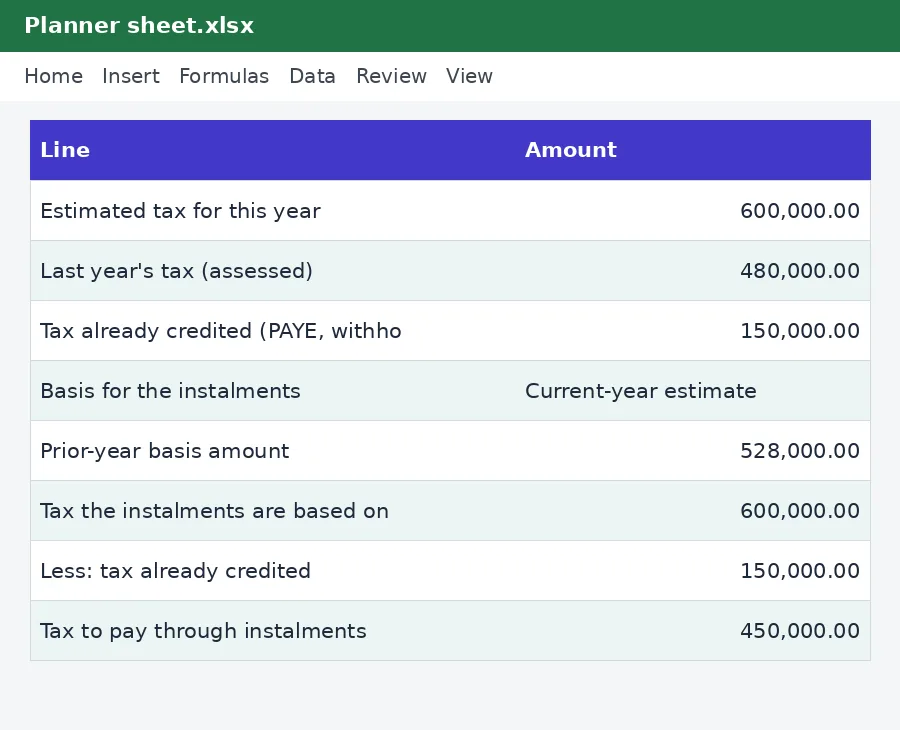
- The tax to pay through instalments: that base less the tax already credited.
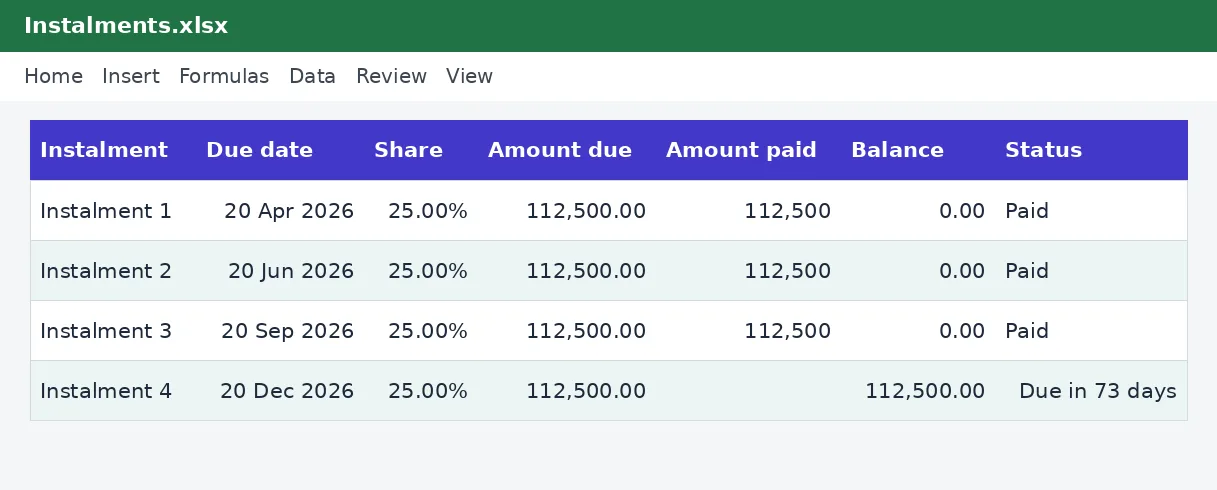
- Each instalment: its due date, its share and its amount.
- What you have paid against each, the balance, and a status of Paid, Due in a number of days, or OVERDUE.
- The reconciliation after you file: final tax per the return, less instalments and credits, leaves a balance still to pay or a refund.
Using it through the year
- At the start of the year, enter your estimate of the tax, last year's tax and the credits you expect.
- Pick the basis and read the four instalments. Put the dates in your calendar and in the filing calendar in this collection.
- Pay each instalment through iTax by its due date and record the amount in the Amount paid column. Keep the receipt.
- Revisit your estimate after the second instalment. If the year is going much better or worse than you thought, adjust the estimate and see how the remaining instalments change.
- After you file, enter the final tax from the return and read the balance.
An example
A consultant expects tax of KES 600,000 for the year. KES 150,000 will be credited through withholding tax deducted by clients. The instalments are based on the remaining KES 450,000, so each of the four quarters is KES 112,500. The sheet shows the due dates, what has been paid and the balance. If the return later shows a final tax of KES 640,000, the reconciliation shows the shortfall of KES 40,000 to pay after filing.
Cash flow and instalments
Instalments are best planned together with your cash flow. A tax bill that arrives four times a year is easier to set aside for than one that arrives in June. Put the instalment amounts in your cash flow forecast and move the money into a separate savings account as you earn. Our instalment tax calculator gives a quick estimate for one case, and the P9 tax return calculator helps estimate the final bill from your salary and other income.
What happens if you pay late or too little
Late or insufficient instalments can lead to interest and penalties, which are worked out by the Revenue Authority under the rules in force. Our KRA penalty calculator explains how those charges build up. Paying a little early, and paying at least what the rules require, is usually cheaper than paying late. Our guide to the 30 June deadline explains what happens at the end of the year.
This planner is a calculation and record-keeping aid and not tax advice. The instalment months, the shares and the percentage on its Rates sheet come from the KenyaTax rates table and have not yet been verified for the period. Whether you must pay instalments at all, and on what basis, depends on your circumstances. Confirm it with the Kenya Revenue Authority or a tax adviser.
Related guides, calculators and templates
- Free calculator: Instalment Tax Calculator
- Guide: How to build a 12-month cash flow forecast for a small business
- Guide: KRA penalties and interest explained: what late filing and payment cost
- Guide: The KRA filing calendar for small businesses: every monthly and yearly deadline
- Another template: Annual income tax estimator
- Another template: KRA filing and payment calendar
- Another template: MRI versus annual rental tax comparison
Need something different? Request a custom template, browse all guides or see every Excel template.
Scroll inside the box to read more.