MRI versus annual rental tax comparison
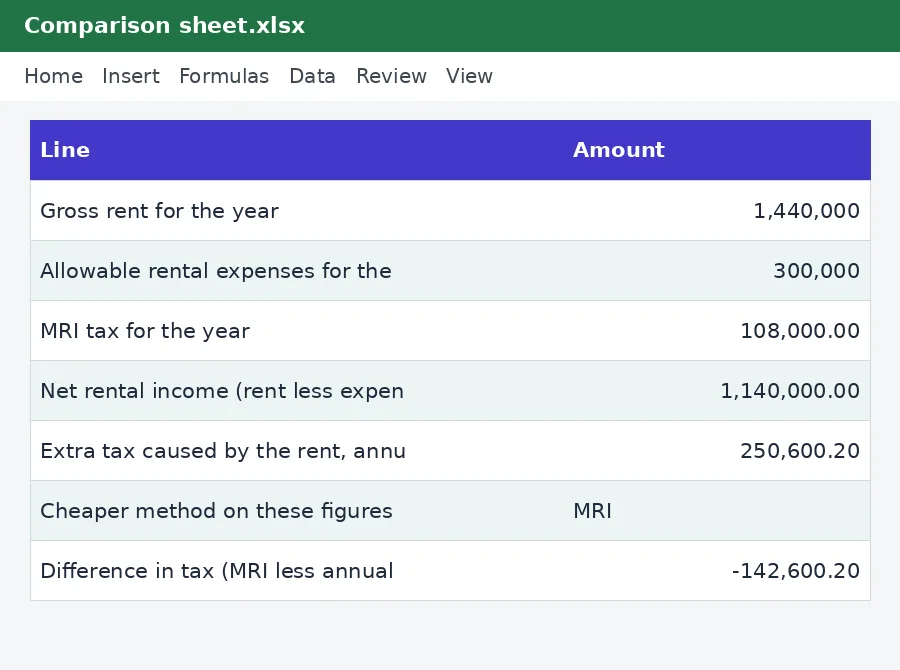
Compare the tax on your rent under the monthly rental income regime with the tax if the rent is taxed with your other income after expenses.

Monthly rental income tax is simple, but it ignores your expenses. Taxing rent with your other income lets you deduct them, but the extra income can push you into a higher band. This workbook puts the two side by side for your figures, and a sensitivity table shows how the answer changes as your expenses rise.
What is included
- MRI tax on gross rent
- Annual-basis tax on net rent with your other income
- Cheaper method and the difference
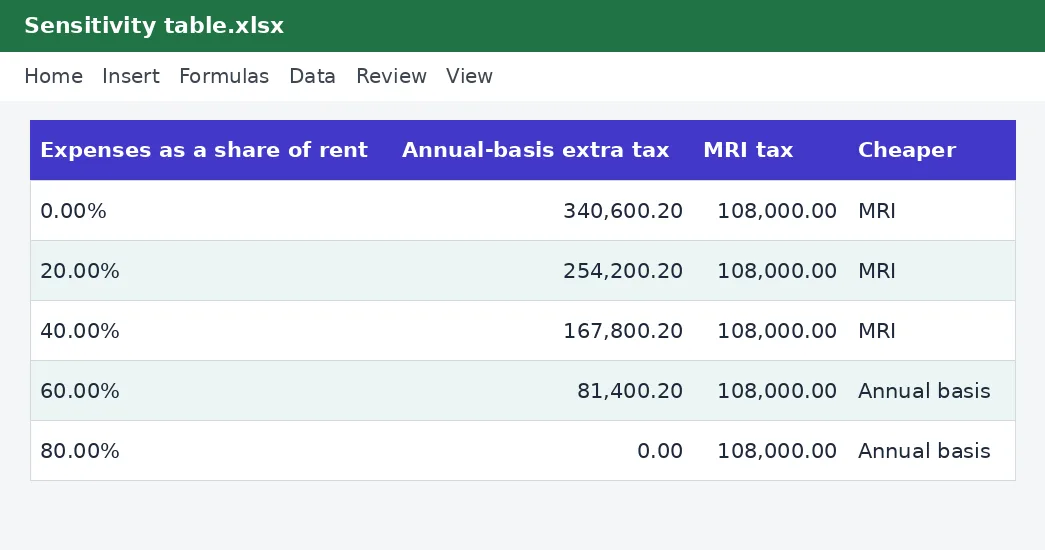
- Table of expense levels from 0% to 80% of rent
- Rate, limits and bands you can update
Advertisement
Screenshots
How to use it
- Check the rates and bands on the Rates sheet.
- Enter rent, expenses and other income.
- Read which method costs less.
- Use the table to see where the answer flips.
Rates and thresholds
Edit the MRI rate, its limits and the tax bands on the Rates sheet.
Templates are tools to help with your own records. They are not tax or legal advice. Check the figures against official sources before filing or paying.
Advertisement
More in this category
-
 Taxpdf
Tax audit survival guide
What to do when KRA announces an audit: the types, your rights, the documents to prepare and how to respond.
KES 1,080KES 1,200-10%
View details →
-
 Taxpdf
Rental income tax guide for landlords
Monthly rental tax or annual return? How landlords register, file, pay and keep records, with a worked example.
KES 720KES 800-10%
View details →
-
 Taxpdf
Withholding tax guide for Kenyan businesses
Who must withhold tax, on which payments, at what rates, and how to remit, issue certificates and keep records.
KES 720KES 800-10%
View details →
Simple is not always cheaper
Monthly rental income tax, or MRI, was designed for convenience. You pay a flat percentage of the gross rent you collect, you file a short return each month, and you never have to add up your repair bills. The price of that convenience is that the tax ignores your costs. For a landlord with a mortgage, an agent, and a building that needs constant repairs, that can mean paying tax on money that was never profit. For a landlord with a paid-off house and few expenses, the same simplicity can be a bargain. This workbook shows you which side of the line you are on.
The two ways of being taxed on rent
A. Monthly rental income (MRI)
Under MRI, the tax is 7.5% of the gross rent for residential property, within annual limits of KES 288,000 and KES 15,000,000. No expenses are deducted. You file and pay each month, and the amount is the same whether the building made a profit or a loss.
B. The annual basis
Under the annual basis, your rental income is the rent less the expenses the law allows, and it is added to your other income, such as a salary, and taxed through the annual bands. The more expenses you have, the lower the taxable income. But the rent is stacked on top of your other income, so if you already earn a high salary, each extra shilling of rental profit is taxed at your highest rate, which can make the annual basis worse even with expenses.
How the workbook compares them
- Enter your gross rent for the year, your allowable rental expenses and any other taxable income.
- The MRI section checks whether your rent is inside the range MRI covers and works out the tax.
- The annual section works out the tax on your other income alone, then on your other income plus the net rent, and takes the difference. That difference is the extra tax caused by the rent.
- The result shows which method gives less tax and by how much.
- The table underneath repeats the annual calculation with expenses at 0%, 10%, 20% and so on up to 80% of the rent, so you can see where the two methods cross.
What you will usually find
With no other income, the annual method starts to look better once expenses rise to a fairly large share of the rent, because personal relief and the lowest band shelter the first part of the profit. With a high salary, the annual method needs much heavier expenses to win, because the rent is taxed at your top rate. The sensitivity table makes these patterns visible. Try changing your other income and watch the break-even point move.
Before you act on the answer
This is a comparison of numbers, not a recommendation. Whether you are free to choose between the methods depends on the rules in force and on your circumstances. Which expenses are allowed, what happens to losses, and how rent from several properties is treated, all matter. Mortgage interest, for example, is limited. Withholding tax on rent paid by a business tenant may also come into the picture, which our withholding tax on rent calculator explains. If MRI applies to you, our rental income tax calculator and the guide to filing a monthly rental income return show how to file.
Using it for planning
- Run it each year before the new tax year, using last year's figures as an estimate.
- Run it before you buy another property or take a loan to renovate, to see the effect on your tax.
- Run it when your salary changes, because that moves the annual-basis answer.
- Take the result to your adviser, together with your records.
Keep the records either way
Even on MRI, where expenses do not reduce the tax, keep your rent receipts, tenancy agreements and bank statements. On the annual basis, you must also keep every invoice for the expenses you claim. Our 30 June deadline guide covers the annual return.
This workbook is a planning aid and not tax advice. The MRI rate, its limits and the tax bands on its Rates sheet come from the KenyaTax rates table and have not yet been verified for the period, so confirm them with the Kenya Revenue Authority before you decide.
Related guides, calculators and templates
- Free calculator: Rental Income Tax Calculator
- Guide: Monthly rental income tax or annual tax: which route is better for a landlord?
- Guide: The 30 June tax deadline
- Guide: How to file a Monthly Rental Income return
- Another template: Monthly rental income (MRI) tracker
- Another template: Annual income tax estimator
- Another template: Instalment tax planner
Need something different? Request a custom template, browse all guides or see every Excel template.
Scroll inside the box to read more.