Fixed asset register with depreciation and capital allowances
Keep a register of everything the business owns, with depreciation, book value and an estimate of the wear and tear allowance for tax.

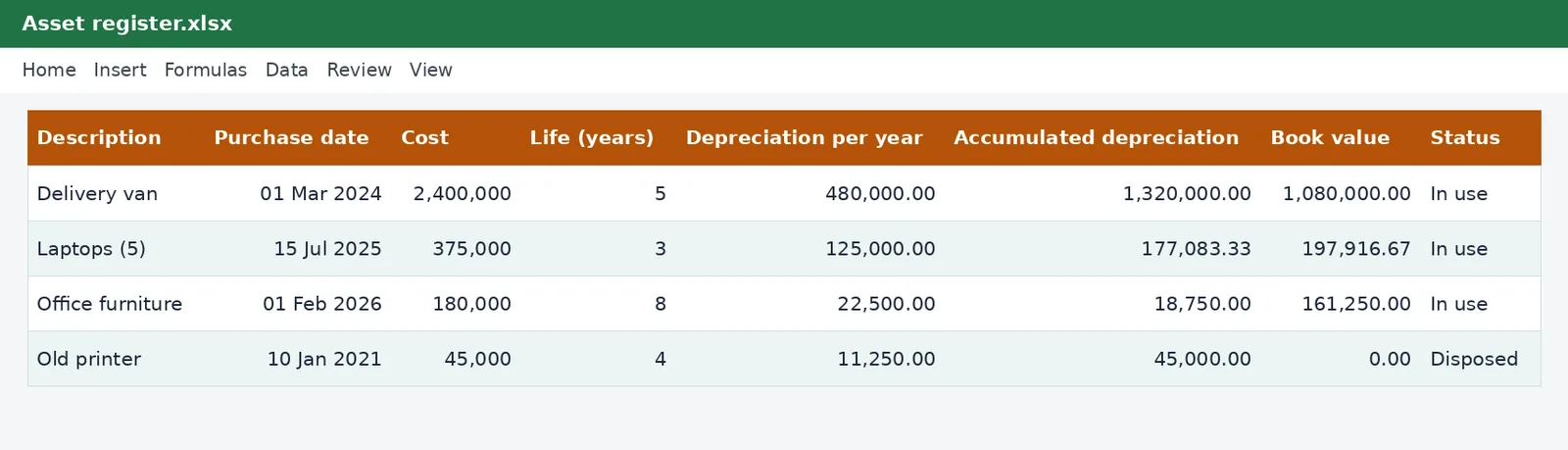
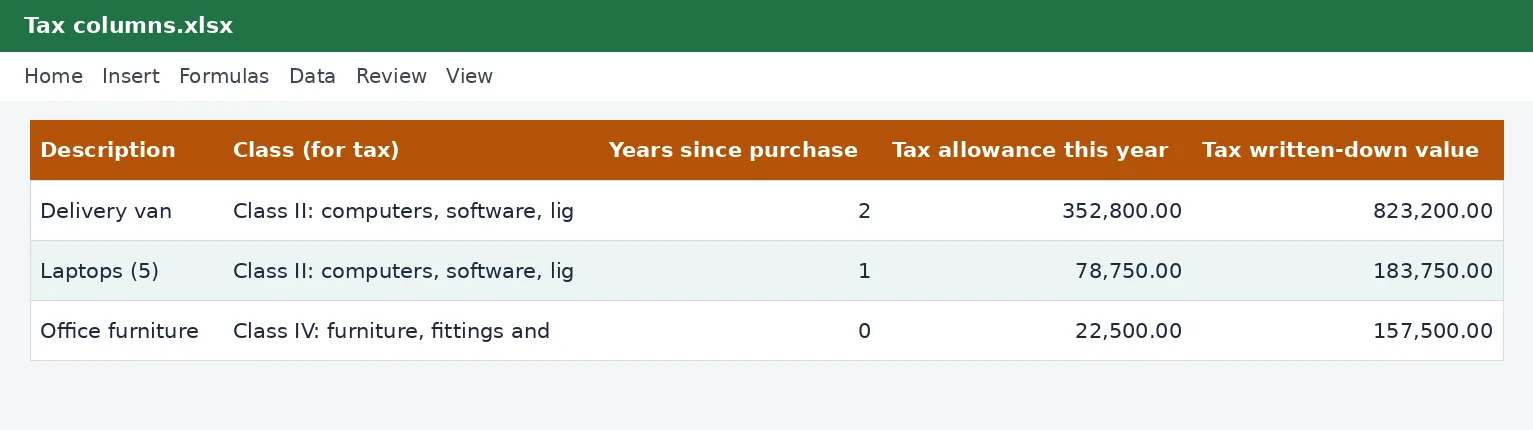
A register of your vehicles, equipment and furniture, with the numbers an accountant asks for at year-end: cost, straight-line depreciation, accumulated depreciation, book value and status. Beside them it estimates the wear and tear allowance for tax by class of asset, and the tax written-down value, so you can see the difference between the books and the tax return.
What is included
- Up to 100 assets
- Straight-line depreciation by month in service
- Book value, disposed and fully depreciated status
- Wear and tear allowance by class (reducing balance)
- Totals for cost, book value and allowance
Advertisement
Screenshots
How to use it
- Check the class rates on the Rates sheet.
- Enter the report date.
- Add each asset with cost, life and class.
- Read the book and tax columns.
Rates and thresholds
Edit the allowance class rates on the Rates sheet.
Templates are tools to help with your own records. They are not tax or legal advice. Check the figures against official sources before filing or paying.
Advertisement
More in this category
-
 Accountingpdf
Credit control policy and collection letters
A credit policy and four collection letters, from a friendly reminder to a final demand, to get paid on time.
KES 810KES 900-10%
View details →
-
 Accountingpdf
Audit preparation guide for small businesses
How to prepare for an annual audit: documents, schedules, timeline and what the auditor will ask.
KES 900KES 1,000-10%
View details →
-
 Accountingpdf
Internal controls checklist for small businesses
A practical checklist of controls that protect a small business from error and fraud: cash, sales, purchases and payroll.
KES 720KES 800-10%
View details →
What you own, what it is worth, and what the taxman lets you claim
Every business buys things that last: a delivery van, laptops, a generator, furniture, machinery. These are fixed assets, and the accounts treat them differently from everyday expenses. You do not deduct the full cost in the year you buy them. Instead the cost is spread over the years the asset is useful, which is called depreciation, and the tax system gives its own allowance, called wear and tear or capital allowance, which follows different rules. A fixed asset register keeps all of this in one place, and this workbook builds it for you.
Two ways of spreading the cost
Depreciation in the accounts
Depreciation is an accounting estimate of how much of an asset's value is used up each year. The simplest method, and the one this workbook uses, is straight line: cost divided by the useful life in years. A van costing KES 2,400,000 with a five-year life depreciates by KES 480,000 a year. The workbook counts the months the asset has been in service, up to the report date or the disposal date, and shows the accumulated depreciation, the depreciation for the current year and the book value, which is cost less accumulated depreciation.
Wear and tear allowance for tax
For tax, the depreciation charged in your accounts is not deductible. Instead you claim an allowance set by the tax law, calculated on a reducing balance for each class of asset. In Kenya assets are grouped into classes with their own annual rates, from heavy machinery and trucks to computers, light vehicles and general equipment and furniture. The Rates sheet lists the classes and their current rates. The workbook estimates, asset by asset, the allowance for the year and the tax written-down value that remains to be claimed in later years.
- Book value is for your accounts and your balance sheet.
- Tax written-down value is for your tax computation.
- The two are usually different, and the difference is a normal part of a tax computation.
Setting up the register
- Check the class rates on the Rates sheet against the current law.
- Enter the date you are reporting at, usually your year end.
- For each asset, add an asset number, a description, the class from the drop-down list, the purchase date, the cost and the useful life in years.
- If you have sold or scrapped an asset, add the disposal date. It is shown as Disposed and stops depreciating.
- Read the totals at the top: total cost, total book value, depreciation this year, the tax allowance and the tax written-down value.
Why a register matters
When an accountant prepares your year-end accounts, the fixed asset schedule is one of the first things they ask for. Without it they have to rebuild it from invoices and bank statements, at your expense. A register also lets you see when a vehicle is fully depreciated and due for replacement, check that you have insured everything you own, and find an asset when someone claims it was never bought. Label each physical asset with its number, and count the assets once a year against the register.
Useful lives
There is no single correct useful life, but typical choices are four to five years for vehicles, three years for computers, and eight to ten for furniture and equipment. Choose a reasonable life and apply it consistently. If your accountant uses different lives, enter theirs.
Disposals, gains and losses
When you sell an asset for more or less than its tax written-down value, the difference may be taxable or deductible. This workbook marks the asset as disposed but does not compute the gain or loss on sale, because the rules depend on the class, the pooling and the circumstances. Keep the sale documents and speak to your adviser. Our capital allowances calculator explains the allowance for a single asset in more detail.
Where it connects
The depreciation total flows into your profit and loss statement, and the allowance into your tax computation, which our corporation tax calculator helps you estimate. Purchase invoices should be eTIMS invoices where required, and our guide to eTIMS explains why that matters for what you can claim.
This register is an estimating and record-keeping tool and not tax or accounting advice. The tax columns simplify the real rules, which pool assets by class and have special treatment for additions, disposals and some vehicles. The class rates on its Rates sheet come from the KenyaTax rates table and have not yet been verified for the period. Confirm everything with your accountant and the Kenya Revenue Authority.
Related guides, calculators and templates
- Free calculator: Capital Allowances and Wear and Tear Calculator
- Guide: Fixed assets and capital allowances explained for small businesses
- Guide: How to keep business records for KRA: what to save and for how long
- Guide: Bank reconciliation step by step: match your books to your bank
- Another template: Bank reconciliation statement
- Another template: Customer invoices and aged receivables tracker
- Another template: Expense tracker with VAT
Need something different? Request a custom template, browse all guides or see every Excel template.
Scroll inside the box to read more.