Monthly profit and loss statement
Revenue, cost of sales, gross profit, expenses, profit before and after tax, with margins and a chart, for every month and the year.

Know whether the business is making money, month by month. Type each month's revenue, cost of sales and expenses and the statement builds the gross profit, operating profit, profit before tax, an estimated tax charge and net profit, with margins and a chart of revenue against profit. The example shows a small trading business over three months.
What is included
- Revenue, cost of sales and ten expense lines
- Gross, operating and net profit
- Estimated income tax at a rate you set
- Gross, operating and net margins
- Chart of revenue and net profit
Advertisement
Screenshots
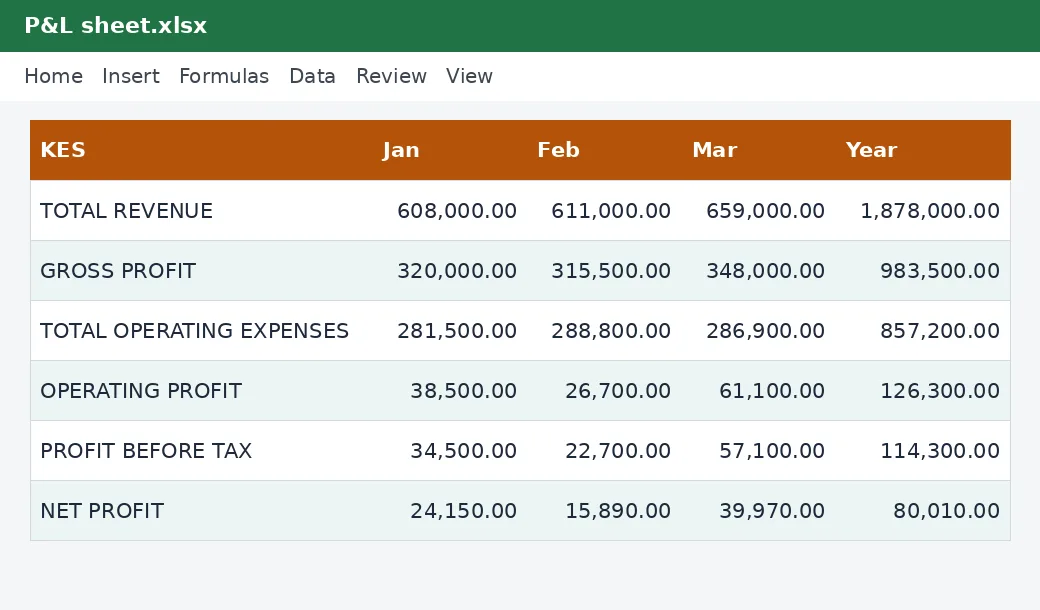
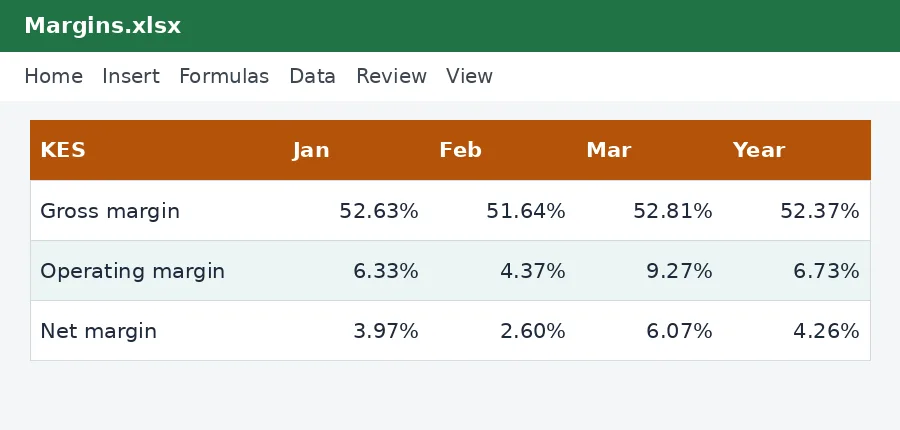
How to use it
- Enter the year and the tax rate.
- Type each month's figures.
- Read the profit lines and the margins.
- Open the Chart sheet.
Rates and thresholds
Edit the estimated tax rate on the Rates sheet.
Templates are tools to help with your own records. They are not tax or legal advice. Check the figures against official sources before filing or paying.
Advertisement
More in this category
-
 Accountingpdf
Credit control policy and collection letters
A credit policy and four collection letters, from a friendly reminder to a final demand, to get paid on time.
KES 810KES 900-10%
View details →
-
 Accountingpdf
Audit preparation guide for small businesses
How to prepare for an annual audit: documents, schedules, timeline and what the auditor will ask.
KES 900KES 1,000-10%
View details →
-
 Accountingpdf
Internal controls checklist for small businesses
A practical checklist of controls that protect a small business from error and fraud: cash, sales, purchases and payroll.
KES 720KES 800-10%
View details →
Are you actually making money?
It is a surprisingly hard question for a small business. The bank balance is not the answer, because it depends on when customers pay and when you pay suppliers. Sales are not the answer, because they say nothing about cost. The answer is profit, and the statement that shows it is the profit and loss account, also called the income statement. This workbook builds one for you month by month: you type the revenue and the costs, and it produces gross profit, operating profit, profit before and after tax and the margins, with a chart.
How a profit and loss statement is built
The statement reads from top to bottom like a short story of the month. First, what you earned. Then what it cost to produce what you sold. The difference is the gross profit. Then the costs of running the business, whether or not you sold anything. What is left is the operating profit. After interest and tax you reach net profit, the money that belongs to the owners.
- Revenue: product sales, service income and other income, with a total.
- Cost of sales: stock and materials, direct labour, delivery and packaging. These rise and fall with your sales.
- Gross profit: revenue less cost of sales, and the gross margin, which is the share of each shilling of sales left after direct costs.
- Operating expenses: salaries, rent, utilities, marketing, transport, professional fees, insurance, depreciation, bank charges and other expenses.
- Operating profit, then interest, giving profit before tax.
- Estimated income tax, at the rate on the Rates sheet, and net profit.
Using the workbook
- On the Rates sheet, check the estimated income tax rate. It starts at the standard company rate of 30%. Change it if your business is taxed differently.
- On the P&L sheet, enter the year, then type each month's figures into the yellow cells. The example shows three months of a small trading business.
- Read the totals and the profit lines. Every month has a column, and the Year column adds them up.
- Look at the margin lines underneath: gross margin, operating margin and net margin.
- Open the Chart sheet for a column chart of revenue and net profit by month.
Where the numbers come from
Take revenue from your sales records or invoices, and costs from your cashbook, supplier bills and payroll. The expense tracker, the supplier bills tracker and the payroll workbook in this collection feed the lines directly. Depreciation comes from the fixed asset register. Use the same categories every month, so that months can be compared.
Reading the margins
Margins tell you more than totals. A gross margin that falls from 50% to 40% means your direct costs are rising faster than your prices, or that you are discounting too much. An operating margin that falls while the gross margin holds means your overheads are growing. A net margin much lower than the operating margin points to a heavy interest or tax charge. Compare each month with the previous one and with the same month last year, and ask what changed.
Tax and the statement
The tax line is an estimate, not your tax return. Real tax is worked out on taxable profit, which adjusts the accounting profit for items the tax law treats differently, such as depreciation, which is replaced by capital allowances, and expenses that are not deductible. Sole traders and small businesses may be taxed differently from companies, which our sole trader versus company calculator compares, and our corporation tax calculator shows the company computation. If your sales are small, you may pay turnover tax on sales, not on profit, and our turnover tax tracker covers that.
A monthly habit
Close the month within ten days: enter the figures, read the margins and write down one thing to change. Keep one workbook for each year, and save a copy at year-end for your accountant. A profit and loss statement kept up to date makes year-end accounts faster, loan applications stronger and decisions better.
This workbook is a management reporting tool and not audited accounts or tax advice. The tax rate on its Rates sheet comes from the KenyaTax rates table and has not yet been verified for the period. Confirm tax treatment with your accountant or the Kenya Revenue Authority.
Related guides, calculators and templates
- Free calculator: Corporation Tax Calculator
- Free calculator: Sole Trader vs Limited Company Tax Calculator
- Guide: Turnover tax for small businesses in Kenya: rate, limits and when to use it
- Guide: Fixed assets and capital allowances explained for small businesses
- Guide: How to keep business records for KRA: what to save and for how long
- Another template: Bank reconciliation statement
- Another template: Customer invoices and aged receivables tracker
- Another template: Expense tracker with VAT
Need something different? Request a custom template, browse all guides or see every Excel template.
Scroll inside the box to read more.