Monthly rental income (MRI) tracker
Record your monthly rent, see the rental income tax due, and keep track of what you paid KRA.

For landlords on the monthly rental income regime. Type each month's gross rent and the tax due is worked out for you. Record what you paid and when, and the workbook shows any balance. A yearly check tells you whether your rent is inside the range this regime covers.
What is included
- Tax due worked out from gross rent
- Payments and balances month by month
- Check against the regime's yearly limits
Advertisement
Screenshots
How to use it
- Check the rate and limits on the Rates sheet.
- Type each month's gross rent.
- Record your payments to KRA.
Rates and thresholds
Edit the Rates sheet if the rate or the limits change.
Templates are tools to help with your own records. They are not tax or legal advice. Check the figures against official sources before filing or paying.
Advertisement
More in this category
-
 Taxpdf
Tax audit survival guide
What to do when KRA announces an audit: the types, your rights, the documents to prepare and how to respond.
KES 1,080KES 1,200-10%
View details →
-
 Taxpdf
Rental income tax guide for landlords
Monthly rental tax or annual return? How landlords register, file, pay and keep records, with a worked example.
KES 720KES 800-10%
View details →
-
 Taxpdf
Withholding tax guide for Kenyan businesses
Who must withhold tax, on which payments, at what rates, and how to remit, issue certificates and keep records.
KES 720KES 800-10%
View details →
Keeping track of rental income tax, month by month
If you let out residential property in Kenya, you may be able to pay tax on your rent through the monthly rental income regime, often called MRI. Instead of calculating profit at the end of the year, you pay a flat percentage of the gross rent you collect, every month, and you do not deduct expenses. That simplicity is attractive, but only if you keep a clean record of what you collected, what you paid and when. This tracker does that, and it works out the tax for you.
How the regime works
MRI applies to resident individuals and companies earning rent from residential property, within an annual limit. At the moment the rate is 7.5% of gross rent, and the regime covers annual rent of between KES 288,000 and KES 15,000,000. Gross rent means everything you receive from the tenant for the use of the property for the month, before any costs. You file and pay each month by the 20th of the following month, through iTax.
- The tax is on gross rent, so repairs, agent fees and loan interest do not reduce it.
- If your rent falls below the lower limit, or above the upper limit, the regime does not apply and different rules govern.
- The regime is for residential property. Commercial lettings are taxed differently.
What the tracker does for you
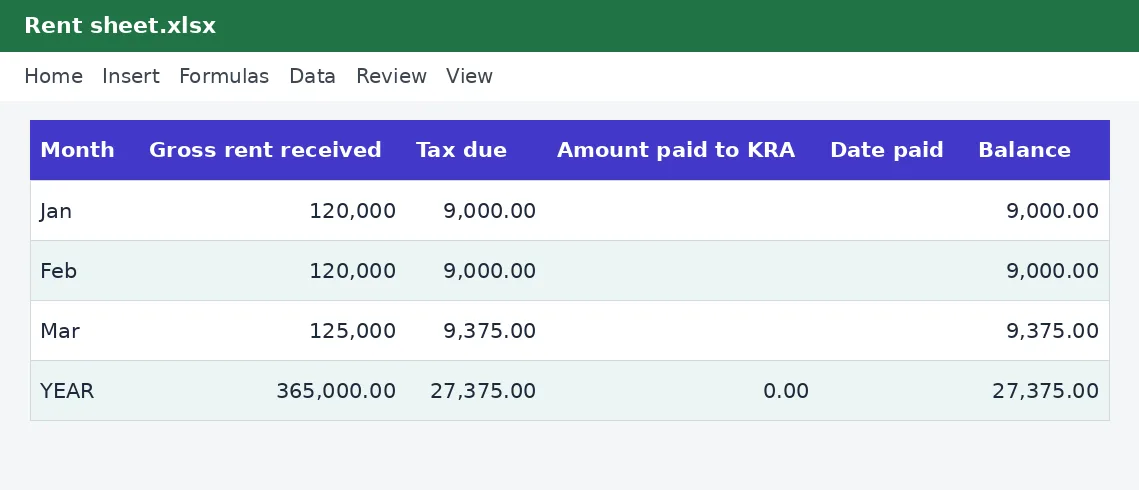
On the Rent sheet you type the gross rent you received for each month, adding all your properties together. The tracker works out the tax due for the month, lets you record the date and amount you paid, and shows a balance for each month. At the bottom, a yearly check compares your total rent with the lower and upper limits on the Rates sheet and tells you whether you are inside the range. All three numbers, the rate and the two limits, are in one place, so if they change you update them once.
An example
Suppose you collect KES 120,000 in January. The tracker multiplies it by the current rate to give the tax due for the month, which you pay by 20 February. It appears in the Tax due column. When you pay, you enter the amount and the date. If you paid less than was due, the Balance column shows what is outstanding.
A routine for landlords
- Check the Rates sheet against the official rate and limits.
- At the start of each month, total the rent you collected the month before.
- Enter it in the tracker and note the tax due.
- Pay through iTax by the 20th and record the payment.
- Keep your rent receipts, tenancy agreements and iTax payment receipts together.
Our guide to filing a monthly rental income return walks through the iTax steps, and the rental income tax calculator lets you compare MRI with taxing rent under the annual rules, which can be better if your costs are high.
When MRI may not be the best choice
Because MRI ignores expenses, it can cost more than the annual method for a landlord whose property has heavy running costs or loan interest. It can cost less for a landlord with few expenses, and the monthly routine is simpler. Whether you can choose depends on your circumstances, and the rules have changed from time to time, so check the current position before you decide. If you let a property through a company or earn other income, speak to a tax adviser.
Late payment and penalties
Missing the monthly deadline attracts a penalty and interest, which can quickly outweigh the tax itself on a small rental. A tracker with a Balance column makes missed months obvious. If you are behind, file and pay as soon as you can. The Kenya Revenue Authority publishes the current penalties.
This tracker is a record-keeping and calculation aid and not tax advice. The rate and limits on its Rates sheet come from the KenyaTax rates table and have not yet been verified for the period, so confirm them with KRA before you pay.
Related guides, calculators and templates
- Free calculator: Rental Income Tax Calculator
- Guide: Monthly rental income tax or annual tax: which route is better for a landlord?
- Guide: The 30 June tax deadline
- Guide: How to file a Monthly Rental Income return
- Another template: MRI versus annual rental tax comparison
- Another template: Annual income tax estimator
- Another template: Instalment tax planner
Need something different? Request a custom template, browse all guides or see every Excel template.
Scroll inside the box to read more.