Staff turnover cost calculator
Work out what it really costs to replace each role: recruitment, training and the weeks the job stays empty.

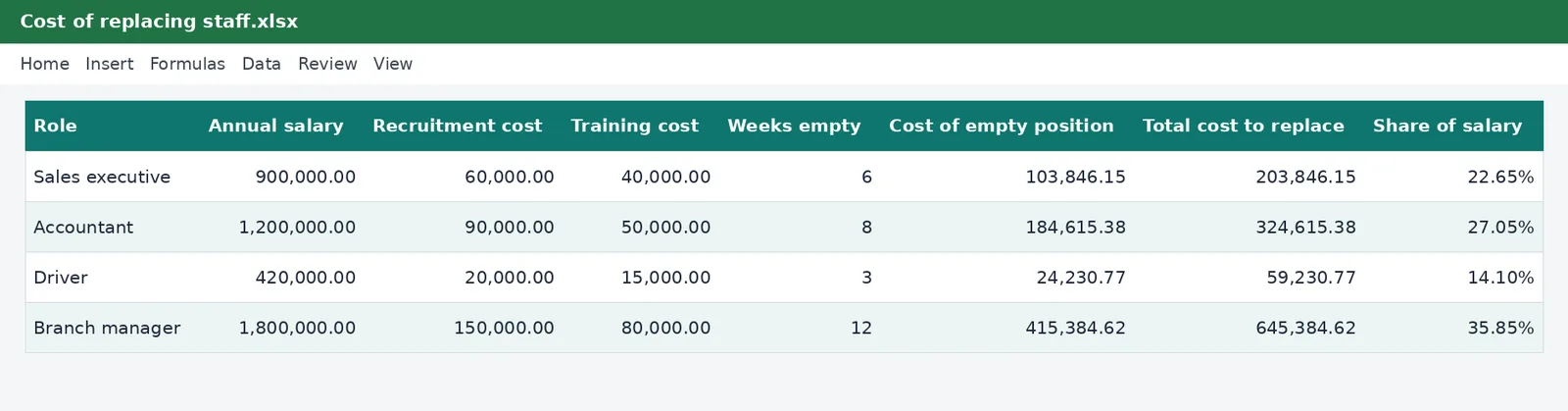
When someone leaves, the cost goes beyond the vacancy advert. For each role enter the salary, the recruitment and training costs and the weeks the position stays empty, and the calculator works out the cost of the empty position, the total cost of replacing the person and that cost as a share of the annual salary, so you can see what keeping people is worth.
Employers, HR officers and owners who want to understand the cost of losing staff, and managers making the case for retention.
What is included
- Recruitment, training and vacancy cost for each role
- Total cost of replacing each person
- Cost as a share of annual salary
- Totals and the average share at the top
- Room for 100 roles
Advertisement
Screenshots
How to use it
- List the roles that you have had to replace, or might.
- Enter the annual salary, the recruitment and training costs.
- Enter the weeks the position was empty.
- Read the total cost and the percentage of salary.
Templates are tools to help with your own records. They are not tax or legal advice. Check the figures against official sources before filing or paying.
Advertisement
More in this category
-
 Payrollpdf
Payroll policy and procedures manual
A written payroll manual: roles, monthly timetable, calculations, approvals, payment, remittances and record keeping.
KES 1,080KES 1,200-10%
View details →
-
 Payrollpdf
Leave policy template for Kenyan employers
A complete leave policy covering annual, sick, maternity, paternity, compassionate and study leave, with how to apply.
KES 540KES 600-10%
View details →
-
 Payrollpdf
Termination and redundancy guide with letters
How to end employment lawfully in Kenya: notice, final dues, redundancy steps and the letters you will need.
KES 900KES 1,000-10%
View details →
What the staff turnover cost calculator does
When someone leaves, the cost goes beyond the vacancy advert. For each role enter the salary, the recruitment and training costs and the weeks the position stays empty, and the calculator works out the cost of the empty position, the total cost of replacing the person and that cost as a share of the annual salary, so you can see what keeping people is worth.
Who it is for
Employers, HR officers and owners who want to understand the cost of losing staff, and managers making the case for retention.
How to use the workbook
- List the roles that you have had to replace, or might.
- Enter the annual salary, the recruitment and training costs.
- Enter the weeks the position was empty.
- Read the total cost and the percentage of salary.
- Save a copy under a new name for each month or year, so earlier records stay as they were.
What is inside
- Recruitment, training and vacancy cost for each role
- Total cost of replacing each person
- Cost as a share of annual salary
- Totals and the average share at the top
- Room for 100 roles
The workbook has these sheets: Instructions, Roles. The main table has the columns Role; Annual salary; Recruitment cost; Training cost; Weeks empty; Cost of empty position; Total cost to replace; Share of salary. Yellow cells are for you to fill in and grey cells calculate by themselves, so leave the grey cells alone. The example rows show how it works; type over them with your own entries.
Tips for getting it right
- Include the time managers spend interviewing and training.
- Use real invoices for advertising and agency fees.
- Compare the cost with a retention budget, such as a pay rise.
- Review the figures each year.
Why keep this record
Staff records go wrong in small, repeated ways: a figure typed twice, a deadline forgotten, a promise that nobody wrote down. A tidy workbook that everyone uses the same way removes most of those problems. It also gives you something to show an employee, an auditor or a labour officer when a question comes up months later, and it makes the next payroll quicker because the facts are already in one place.
Questions people ask
Do I need to know Excel formulas? No. Type into the yellow cells and the rest is worked out for you. The formulas are visible if you want to see how a figure is reached.
Can I add rows or change the layout? You can add your own columns to the right and your own notes. If you insert rows inside a table, copy the grey formula cells down so the new rows calculate too.
Will it work on my phone or in Google Sheets? Yes for viewing and typing, but dropdown lists and the charts look best in desktop Excel or LibreOffice.
Keeping it safe and up to date
Payroll records are personal data and tax records at once, so keep the file somewhere only the people who need it can open, and keep each month's copy for at least five years. Statutory rates such as NSSF limits and the Housing Levy change, so check the Rates sheet against the official source before you rely on a figure.
Read how to run payroll for a small business for the wider picture. Free calculators that go with it: Net to gross salary calculator. See more payroll templates or ask us for a custom one.
The workbook works in Microsoft Excel, LibreOffice and Google Sheets. It is a tool to help you work out and record figures, not tax, legal or accounting advice, and it is not affiliated with the Kenya Revenue Authority. If something does not work as described, contact us and we will put it right.
Related guides, calculators and templates
- Free calculator: Net to Gross Salary Calculator
- Guide: How to prepare for a performance review and a salary talk
- Guide: Caretakers and property managers: roles, pay and oversight
- Guide: How to handle a pay delay from your employer
- Another template: Employee cost to company calculator
- Another template: Gross-to-net salary table
- Another template: Net pay bank and M-Pesa payment schedule
Need something different? Request a custom template, browse all guides or see every Excel template.
Scroll inside the box to read more.