Supplier bills and accounts payable tracker
Record every supplier bill with its due date and payments, and see what is overdue, what falls due soon and what you owe each supplier.

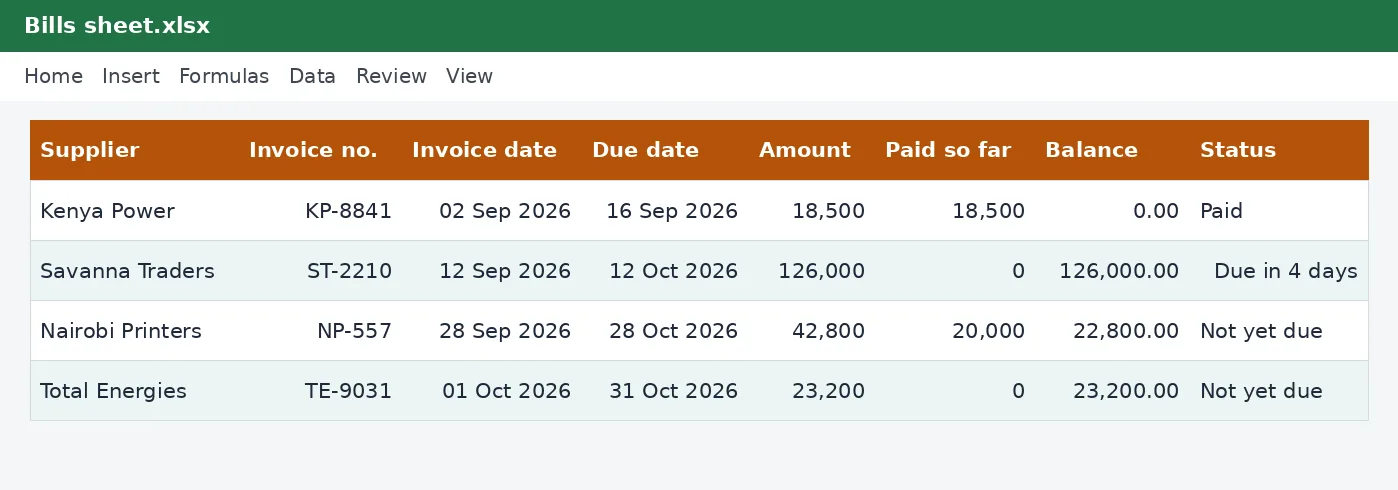
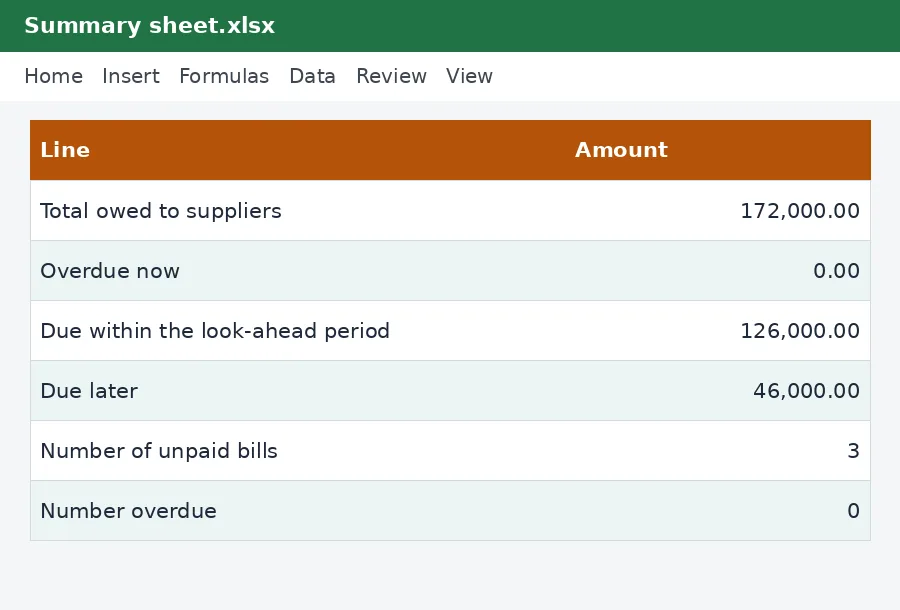
Pay the right bill at the right time. Every supplier invoice goes in with its date and terms, and the tracker works out the due date, the balance and a status that says Paid, Due in a number of days or OVERDUE. The summary shows the total you owe, what is overdue, what falls due in the next two weeks and the balance for each supplier.
What is included
- Up to 300 bills with part payments
- Due dates and clear status
- Overdue and due-soon totals
- Balance by supplier
- Look-ahead period you can change
Advertisement
Screenshots
How to use it
- Set the terms and look-ahead on the Rates sheet.
- Enter each supplier bill.
- Record payments as you make them.
- Check the Summary every week.
Rates and thresholds
Edit the terms and the look-ahead days on the Rates sheet.
Templates are tools to help with your own records. They are not tax or legal advice. Check the figures against official sources before filing or paying.
Advertisement
More in this category
-
 Accountingpdf
Credit control policy and collection letters
A credit policy and four collection letters, from a friendly reminder to a final demand, to get paid on time.
KES 810KES 900-10%
View details →
-
 Accountingpdf
Audit preparation guide for small businesses
How to prepare for an annual audit: documents, schedules, timeline and what the auditor will ask.
KES 900KES 1,000-10%
View details →
-
 Accountingpdf
Internal controls checklist for small businesses
A practical checklist of controls that protect a small business from error and fraud: cash, sales, purchases and payroll.
KES 720KES 800-10%
View details →
Paying on time is a skill, and a tool helps
Suppliers are your cheapest lenders, as long as you pay them when you promised. Pay late and you lose their goodwill, their discounts and sometimes their supply. Pay early and you hand over cash you could have used. Pay twice and you lose money that is hard to get back. A payables tracker keeps all your supplier bills in one list, with the due dates and balances, so the decision about what to pay this week is made with the facts in front of you.
What the tracker records
On the Bills sheet, add a row for each supplier invoice: the supplier, the invoice number, the invoice date, the terms in days, and the amount. If you leave the terms blank, the usual terms from the Rates sheet are used. As you pay, type the amount in Paid so far, which handles part payments. The tracker works out:
- the due date, from the invoice date and the terms;
- the balance still owing;
- a status: Paid, Not yet due, Due in a number of days, or OVERDUE with the days late;
- a place for the payment method or a note, such as a cheque number or an M-Pesa reference.
The summary sheet
The Summary sheet answers the questions you ask on a Monday morning. How much do we owe in total? How much is overdue? How much falls due in the next fourteen days, or whatever look-ahead you set? How much later? How many bills are unpaid, and how many are overdue? A table lists the balance for each supplier whose name you type, which helps when a supplier phones to ask about their account. Use it to build a payment run: pay what is overdue first, then what is due soon, in the order your cash allows.
Payments and cash flow
The look-ahead total is the number to put into your cash flow forecast. If the bills due in the next two weeks are more than the cash you expect to have, you can talk to suppliers early, which is a very different conversation from the one you have after you have already missed the date. Our 12-month cash flow forecast in this collection puts those payments against your expected receipts.
Good habits
- Enter every bill the day it arrives, even if you will not pay it for weeks.
- Check each bill against the order and the delivery before you approve it.
- Make payment runs on fixed days, for example every Tuesday and Friday.
- Record each payment immediately, with the reference.
- Once a month, ask your main suppliers for a statement and compare it with the tracker.
- Take early-payment discounts when they are worth more than the cost of the cash.
Tax points on supplier payments
Some payments to suppliers carry withholding tax, which you must deduct from the payment and send to the Revenue Authority. Professional fees, contractual fees, commissions, royalties and rent are common examples, and rates differ for residents and non-residents. Our withholding tax calculator shows the amount on one payment and the withholding tax schedule in this collection records and totals them. If you claim VAT on a supplier's bill, you generally need a valid tax invoice, which is increasingly an electronic one: see our guide to eTIMS e-invoicing. Keep every bill and proof of payment for at least five years.
Control and fraud
Payables is a favourite target for fraud: fake suppliers, inflated invoices and duplicate payments. Keep the person who approves bills separate from the person who pays them, check new supplier bank details by phoning a number you already have, and watch for the same invoice number entered twice. The tracker makes duplicates easier to see, because every bill sits in one list.
This workbook is a record-keeping tool and not accounting, legal or tax advice. Payment terms are as agreed with your suppliers. For tax obligations, see the Kenya Revenue Authority or ask your accountant.
Related guides, calculators and templates
- Free calculator: Withholding Tax Calculator
- Guide: Withholding tax in Kenya explained: rates, agents and credits
- Guide: How to get a KRA PIN
- Guide: How to keep business records for KRA: what to save and for how long
- Another template: Bank reconciliation statement
- Another template: Customer invoices and aged receivables tracker
- Another template: Expense tracker with VAT
Need something different? Request a custom template, browse all guides or see every Excel template.
Scroll inside the box to read more.