Tax records checklist and document log
A checklist of the records KRA expects you to keep, with where each one is, when you last checked it, and a log that shows how long to keep every document.

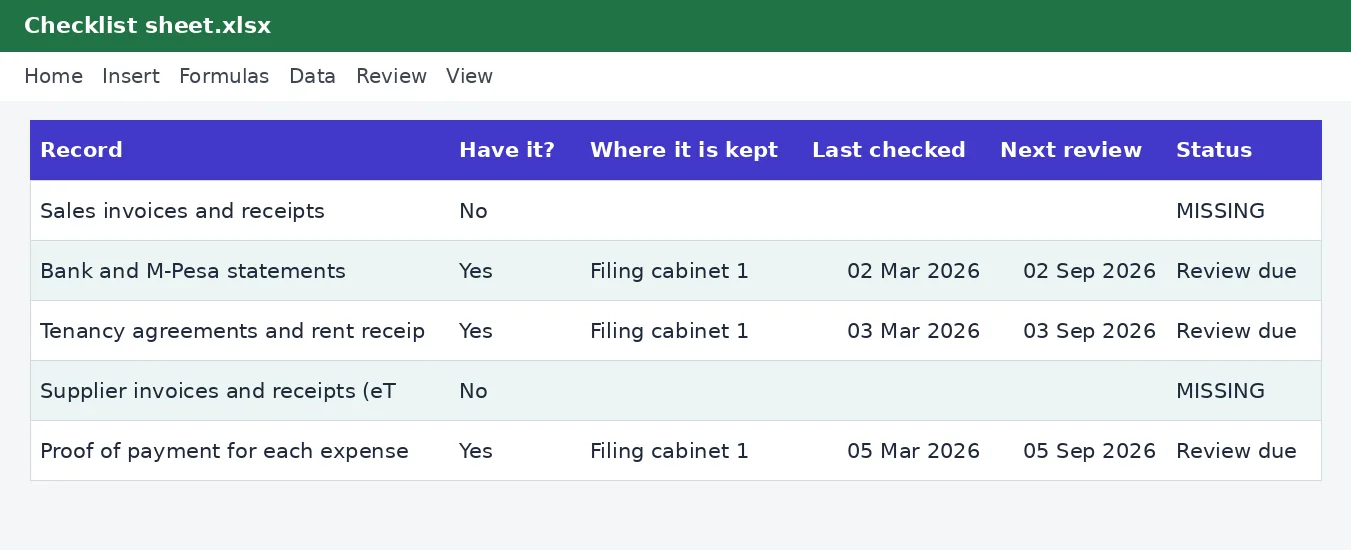
When KRA asks for evidence, the question is never whether you have a record, it is whether you can find it. This workbook lists the tax records every business and landlord should hold, lets you note where each is kept, flags what is missing, and logs important documents with the date until which you must keep them.
What is included
- 16 record types with the reason you need each
- Where it is kept, last checked and next review
- MISSING and review-due flags
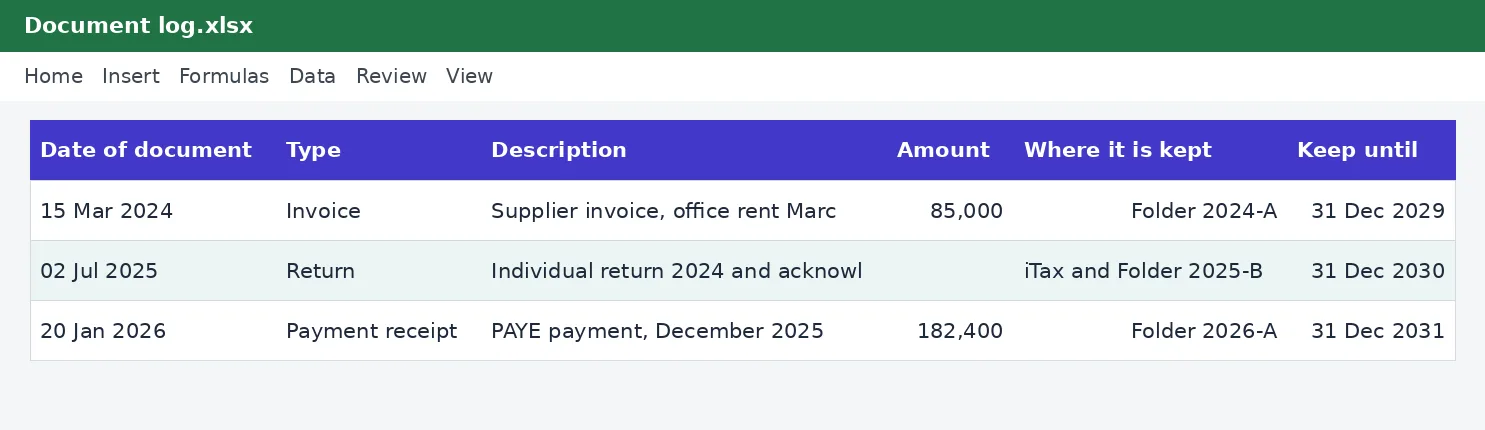
- Document log with a keep-until date
- Retention period you can change
Advertisement
Screenshots
How to use it
- Set the retention period and review interval on the Rates sheet.
- Answer Yes or No for each record on the Checklist.
- Log important documents as you receive them.
- Fix anything marked MISSING.
Rates and thresholds
Edit the retention period on the Rates sheet.
Templates are tools to help with your own records. They are not tax or legal advice. Check the figures against official sources before filing or paying.
Advertisement
More in this category
-
 Taxpdf
Tax audit survival guide
What to do when KRA announces an audit: the types, your rights, the documents to prepare and how to respond.
KES 1,080KES 1,200-10%
View details →
-
 Taxpdf
Rental income tax guide for landlords
Monthly rental tax or annual return? How landlords register, file, pay and keep records, with a worked example.
KES 720KES 800-10%
View details →
-
 Taxpdf
Withholding tax guide for Kenyan businesses
Who must withhold tax, on which payments, at what rates, and how to remit, issue certificates and keep records.
KES 720KES 800-10%
View details →
When KRA asks for proof, you need to find it, not remember it
A tax return is a set of claims: this much income, these expenses, that much paid. A query from the Kenya Revenue Authority is simply a request for the evidence behind those claims, usually months or years afterwards. The business that wins that conversation is not the one with the best memory but the one that kept the right records and knows where they are. This free workbook lists the records you should hold, tracks whether you have them, and shows how long you must keep each document.
The records that matter
The checklist groups sixteen kinds of record under income, expenses, payroll, tax returns, assets, registration and correspondence. Each has a short reason, because it helps to know why a record matters: a supplier invoice supports an expense and a VAT claim; a payslip register supports PAYE; a payment receipt proves you paid. For each one you say whether you have it, where it is, and when you last checked. The workbook then tells you which records are missing and which are due for a review.
- Income: sales invoices, till rolls, bank and M-Pesa statements, tenancy agreements.
- Expenses: invoices and receipts, ideally from the supplier's eTIMS system where it is required, with proof of payment.
- Payroll: payslips, the payroll register, P9 forms and the payment receipts for every remittance.
- Tax returns: filed returns, acknowledgement receipts, iTax payment receipts and withholding tax certificates.
- Assets and loans: purchase documents, loan agreements and interest statements.
How long to keep them
Under the Tax Procedures Act, taxpayers are generally required to keep records for at least five years after the end of the tax year to which they relate. The Rates sheet sets the number of years, and the Document log works out a keep-until date for every document you log by taking the end of the year of the document and adding the retention period. Some records should be kept for longer: documents for assets you still own, documents relating to an open query or dispute, and contracts that are still running. When in doubt, keep it.
Why eTIMS matters for your expense records
For many expenses, the receipt or invoice is now expected to come from KRA's electronic tax invoice system. An expense without a valid electronic invoice may be challenged, and VAT on it may not be claimable. Our guide to eTIMS e-invoicing explains what you need to ask suppliers for. Put that into your checklist: ask for the right document at the time, not a year later.
Using the workbook
- On the Rates sheet, set the number of years you keep records and how often you review the checklist.
- On the Checklist sheet, answer Yes or No for each record, say where it is kept and enter the date you last checked.
- Anything marked MISSING in red is a gap. Decide who will fix it and by when.
- Use the Document log for documents you want to be able to find quickly: a contract, a return, a notice, a large invoice. Enter the date, the type, a short description, the amount and where it is kept.
- Review the checklist every six months, or whenever you change accountant, bank or office.
Paper, digital or both
Digital copies are fine, provided they are legible, complete and can be produced when asked. Scan or photograph documents when you receive them, name the files with the date and the supplier, and back them up to a second place. Paper receipts fade, particularly thermal ones, so scanning is a good habit even if you keep the original. Write the location in the log, such as a folder name, a drive or a cabinet, so that someone else can find it.
Keep your records private
Tax records contain personal and commercial information. Store them securely, share them only with people who need them, and do not send identity or bank details by email without protecting them. If you work with an accountant, give them copies, and keep the originals.
This workbook is a record-keeping aid and not legal or tax advice. Retention periods and documentation requirements depend on the tax and the circumstances. For the rules that apply to you, see the Kenya Revenue Authority or ask a tax adviser. Our guide to registering on iTax shows where returns and receipts are stored online.
Related guides, calculators and templates
- Guide: The KRA filing calendar for small businesses: every monthly and yearly deadline
- Guide: KRA penalties and interest explained: what late filing and payment cost
- Guide: How to keep business records for KRA: what to save and for how long
- Another template: Annual income tax estimator
- Another template: Instalment tax planner
- Another template: KRA filing and payment calendar
Need something different? Request a custom template, browse all guides or see every Excel template.
Scroll inside the box to read more.