Budget versus actual tracker
Set a budget for the year, record what really happened each month, and see where you are over or under, month by month and year to date.

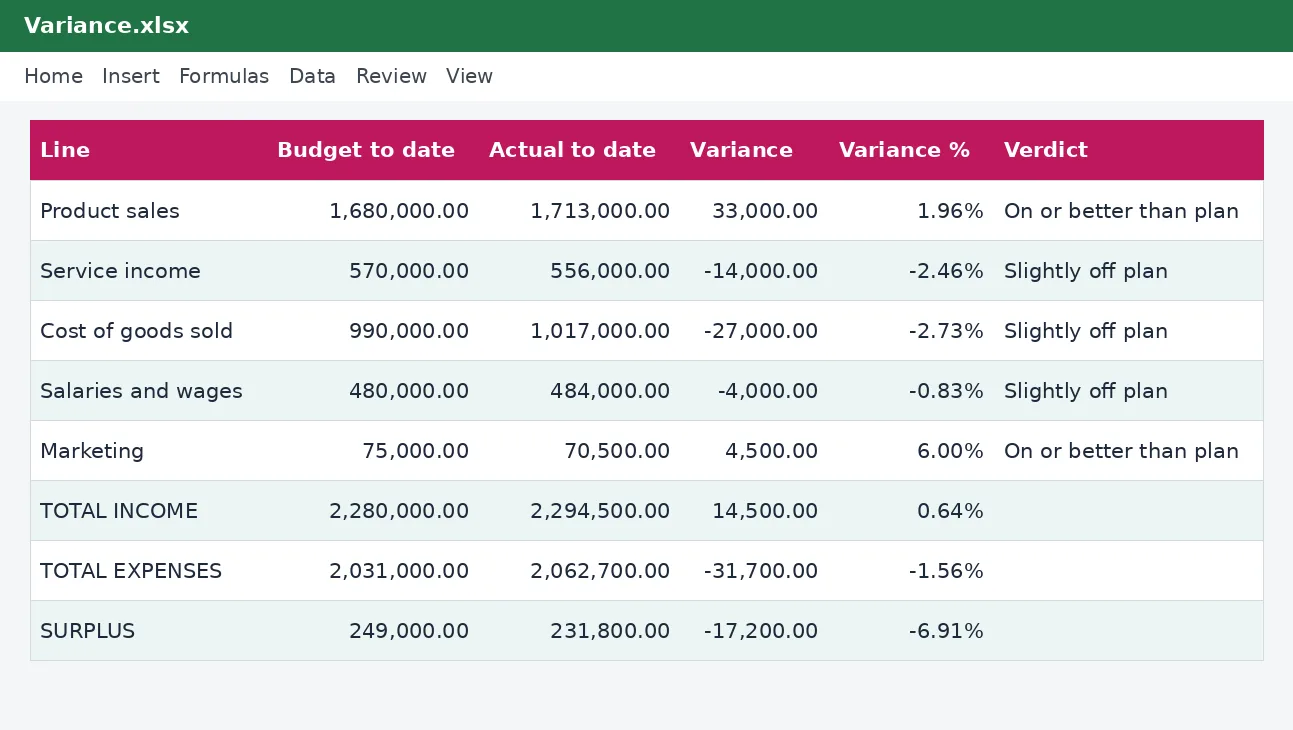
A budget only helps if you compare it with reality. Enter the planned income and spending for each line and month, then the actual figures as the year goes on. The Variance sheet compares them for any number of months, tells you for each line whether you are on or better than plan, slightly off or OFF PLAN, and shows the total surplus against budget.
What is included
- Three income and ten expense lines by month
- Budget, Actual and Variance sheets
- Year-to-date comparison for any month
- Variance in amount and percentage
- OFF PLAN flags
Advertisement
Screenshots
How to use it
- Enter the budget for each month.
- Enter the actual figures as they happen.
- Choose the month to report up to.
- Investigate lines marked OFF PLAN.
Templates are tools to help with your own records. They are not tax or legal advice. Check the figures against official sources before filing or paying.
Advertisement
More in this category
-
 Businesspdf
Small business funding guide for Kenya
The main ways Kenyan small businesses raise money: savings, loans, SACCOs, mobile lenders, grants and investors.
KES 720KES 800-10%
View details →
-
 Businesspdf
SOP writing guide and templates
How to write standard operating procedures that people actually use, with templates for a process, a checklist and a training record.
KES 810KES 900-10%
View details →
-
 Businesspdf
Sales proposal and quotation pack
Win more work with a clear proposal, a professional quotation and a follow-up letter, with a checklist for each step.
KES 630KES 700-10%
View details →
A budget is a promise. Variance tells you if you kept it.
Most small businesses make a budget in January and look at it again in December, if they find it. By then the information is useless. The value of a budget is in the comparison: what did we plan, what really happened, and why do they differ? Done every month, that comparison is the cheapest management tool there is. It shows problems while they are small, it rewards good decisions and it makes the next budget better. This workbook gives you the structure and does the sums.
Three sheets that work together
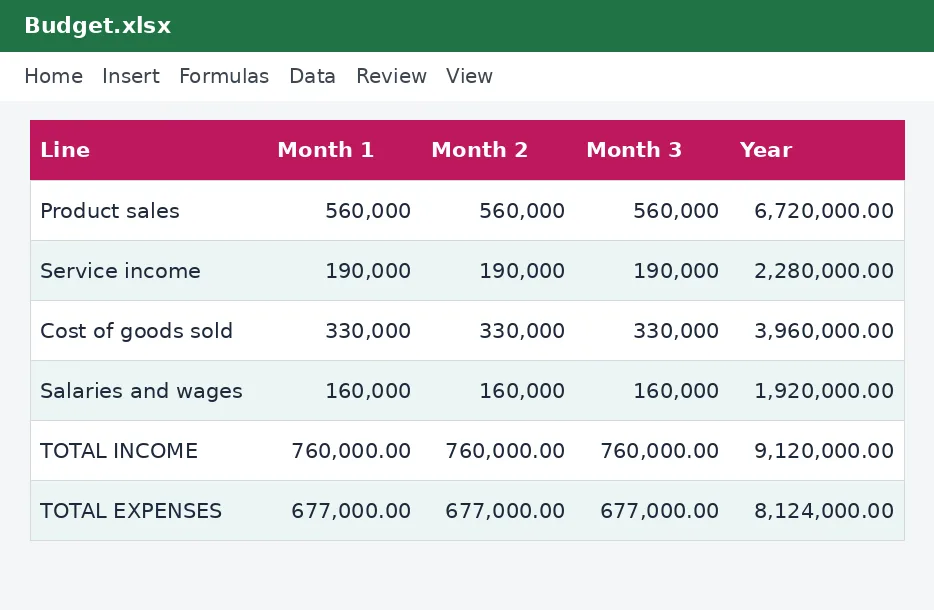
The Budget sheet lists three lines of income and ten lines of expenses, with a column for each month. Enter what you plan to earn and spend. The Actual sheet has exactly the same layout: enter what really happened, month by month, as the year goes on. The Variance sheet compares them. You choose how many months to report on, and for each line it shows the budget to date, the actual to date, the variance in shillings and as a percentage, and a verdict.
- For income, variance is actual minus budget: earning more than planned is positive.
- For expenses, variance is budget minus actual: spending less than planned is positive.
- Positive is always good for you, and negative is always a warning.
The verdict column
Each line is marked On or better than plan, Slightly off plan if the shortfall is within five per cent of the budget, or OFF PLAN, highlighted in red, if it is more. At the bottom, total income, total expenses and the surplus are compared in the same way. A line that is slightly off needs a note. A line that is OFF PLAN needs an explanation and a decision.
How to build a budget you can use
- Start from last year's actual figures. They are better than guesses.
- Adjust for what you know will change: price rises, a new employee, a rent increase, a new product.
- Be realistic about income. It is safer to budget slightly low on sales and slightly high on costs.
- Include the costs that arrive irregularly: insurance, licences, tax payments, repairs and annual subscriptions.
- Include your tax payments in the Taxes and levies line, using our filing calendar and tax payments log in this collection to remember them.
- Keep the number of lines small enough to maintain every month.
The monthly review
Within a week of the month-end, enter the actual figures and open the Variance sheet. Start with the surplus at the bottom: are you ahead or behind for the year to date? Then look at the largest variances, favourable and adverse. For each, ask what caused it, whether it will continue and what you will do. Write the answers in a notebook or in the margin of the workbook. If a variance is a timing difference, such as an annual insurance bill paid early, it will reverse. If it is a trend, such as the cost of fuel creeping up, your budget for the remaining months needs changing.
Changing the budget during the year
There is no shame in revising a budget. Keep the original, so that you can see how far you moved, and update the remaining months for what you now know. A budget that is adjusted for reality becomes a forecast, which is exactly what a bank or an investor wants to see. Our 12-month cash flow forecast in this collection turns the same plan into a month-by-month bank balance.
Linking it to the rest of your records
The actual figures come from your accounting records: the cashbook, the profit and loss statement, the expense tracker and the payroll workbook. If a total here does not match those records, find the difference before you rely on the variances. Keep each year's workbook with your accounts, because it shows how the numbers were planned as well as how they turned out, and tax records should be kept for at least five years.
This workbook is a planning and control tool and not financial or tax advice. The example figures are illustrations. For tax payments and deadlines, see the Kenya Revenue Authority and our 30 June deadline guide, and speak to an accountant for anything beyond a simple budget.
Related guides, calculators and templates
- Guide: How to build a 12-month cash flow forecast for a small business
- Guide: How to price your products and services: markup, margin and break-even
- Guide: Turnover tax for small businesses in Kenya: rate, limits and when to use it
- Another template: 12-month cash flow forecast
- Another template: Break-even and pricing calculator
- Another template: Inventory and stock tracker with reorder alerts
Need something different? Request a custom template, browse all guides or see every Excel template.
Scroll inside the box to read more.