Overtime and leave tracker
Work out overtime pay for each employee and keep a running balance of their annual leave.

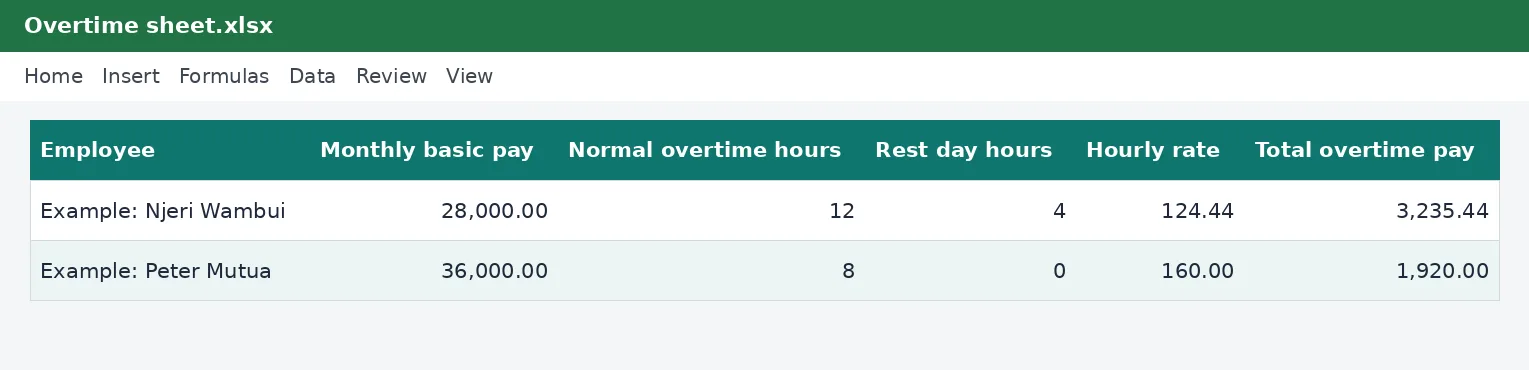
Two sheets in one file. The first works out each person's overtime pay for the month at the normal and rest-day rates. The second tracks annual leave: entitlement, days taken and days remaining, with a warning when someone is running low.
What is included
- Hourly rate worked out from monthly pay
- Normal and rest-day overtime rates
- Leave balance with a low-balance warning
- Up to 40 employees
Advertisement
Screenshots
How to use it
- Check the multipliers on the Rates sheet.
- Enter monthly pay and overtime hours on the Overtime sheet.
- Record leave taken on the Leave sheet.
Rates and thresholds
Edit the Rates sheet for different overtime multipliers or leave entitlements.
Templates are tools to help with your own records. They are not tax or legal advice. Check the figures against official sources before filing or paying.
Advertisement
More in this category
-
 Payrollpdf
Payroll policy and procedures manual
A written payroll manual: roles, monthly timetable, calculations, approvals, payment, remittances and record keeping.
KES 1,080KES 1,200-10%
View details →
-
 Payrollpdf
Leave policy template for Kenyan employers
A complete leave policy covering annual, sick, maternity, paternity, compassionate and study leave, with how to apply.
KES 540KES 600-10%
View details →
-
 Payrollpdf
Termination and redundancy guide with letters
How to end employment lawfully in Kenya: notice, final dues, redundancy steps and the letters you will need.
KES 900KES 1,000-10%
View details →
Two jobs every employer has to do properly: overtime and leave
Overtime pay and annual leave are two of the most common sources of disagreement between employers and employees, and almost all of them come down to records. How many extra hours did someone work? At what rate are they paid? How many days of leave have they taken, and how many are left? When the answers live in people's memories or in scattered notebooks, disputes follow. This workbook gives you a clean place to record both, with the sums done for you.
Working out overtime pay
The Overtime sheet takes each employee's monthly basic pay and their overtime hours, and works out what they are owed. First it finds the hourly rate by dividing monthly pay by the standard working hours in a month, which are set on the Rates sheet. Then it multiplies by the overtime rate for each kind of hour.
- Normal overtime, the extra hours on an ordinary working day, is generally paid at one and a half times the normal hourly rate.
- Rest-day and public-holiday work is generally paid at twice the normal hourly rate.
These are the general minimums under the Employment Act and the regulations of wages orders. Some wage orders, collective agreements and contracts provide more, and some categories of employee, such as managers who are not paid by the hour, may be treated differently. Check your employee's contract and the wage order for their sector, and change the multipliers on the Rates sheet if yours differ.
An example
An employee earns KES 28,000 a month and works twelve hours of normal overtime and four hours on a rest day. The workbook divides the monthly pay by the standard hours to get the hourly rate, multiplies the normal hours by that rate and the normal overtime multiplier, does the same for the rest-day hours with the rest-day multiplier, and adds the two. Each step is in its own column, so you can see exactly how the total was reached. It does this for every employee at once and totals the month's overtime so you can add it to payroll. The two example employees in the file show how it works. Type over them with your own staff.
Tracking annual leave
The Employment Act gives employees a minimum number of paid leave days each year after a period of service. The Leave sheet starts every employee with the entitlement on the Rates sheet, currently 21 working days, and you record the days each person takes. It shows days remaining and gives a status: OK, Low when three days or fewer remain, or Over entitlement if someone has taken more than they are due.
Keeping this up to date has practical benefits. You can plan cover during busy periods, you avoid surprises when someone resigns and you need to calculate unused leave to pay out, and you can show an employee exactly where they stand. The tracker holds up to 40 employees, and you can copy the sheet to start a new year.
Getting the most from the tracker
- On the Rates sheet, check the overtime multipliers, the standard hours and the leave entitlement against your contracts.
- List your employees on the Overtime sheet with their monthly basic pay.
- At the end of each month, enter the normal and rest-day overtime hours for each person.
- Add the total from the sheet to the month's payroll, either in the payroll workbook or your own system.
- As leave is taken, record the days on the Leave sheet and review it monthly.
Overtime is pay, so it is taxed
Overtime is part of an employee's earnings, so it forms part of gross pay and is subject to PAYE, NSSF, SHIF and the Housing Levy like the rest of the salary. When you add overtime to a month's pay, the statutory deductions on that month go up too. The KenyaTax overtime pay calculator can help with one-off questions, and the PAYE calculator shows the effect on take-home pay.
A note on accuracy
This tracker records and calculates. It is not legal advice, and the entitlements it uses are general minimums. Your employment contract, the applicable wage order or a collective agreement may give employees more. The figures on the Rates sheet come from the KenyaTax rates table and have not yet been verified for the period, so confirm them against official sources, such as the Kenya Revenue Authority and the Ministry of Labour, before relying on them.
Related guides, calculators and templates
- Free calculator: Overtime Pay Calculator
- Guide: How to run payroll for a small business in Kenya
- Guide: How PAYE is calculated in Kenya, step by step
- Guide: NSSF contributions explained: tiers, limits and what you pay
- Another template: Annual leave planner and register
- Another template: Annual PAYE and payroll summary
- Another template: Employee records register and contract tracker
Need something different? Request a custom template, browse all guides or see every Excel template.
Scroll inside the box to read more.