Seasonal sales and stock planner
Plan monthly sales from last year's figures and expected growth, work out how much stock to buy and track actual sales against the plan.

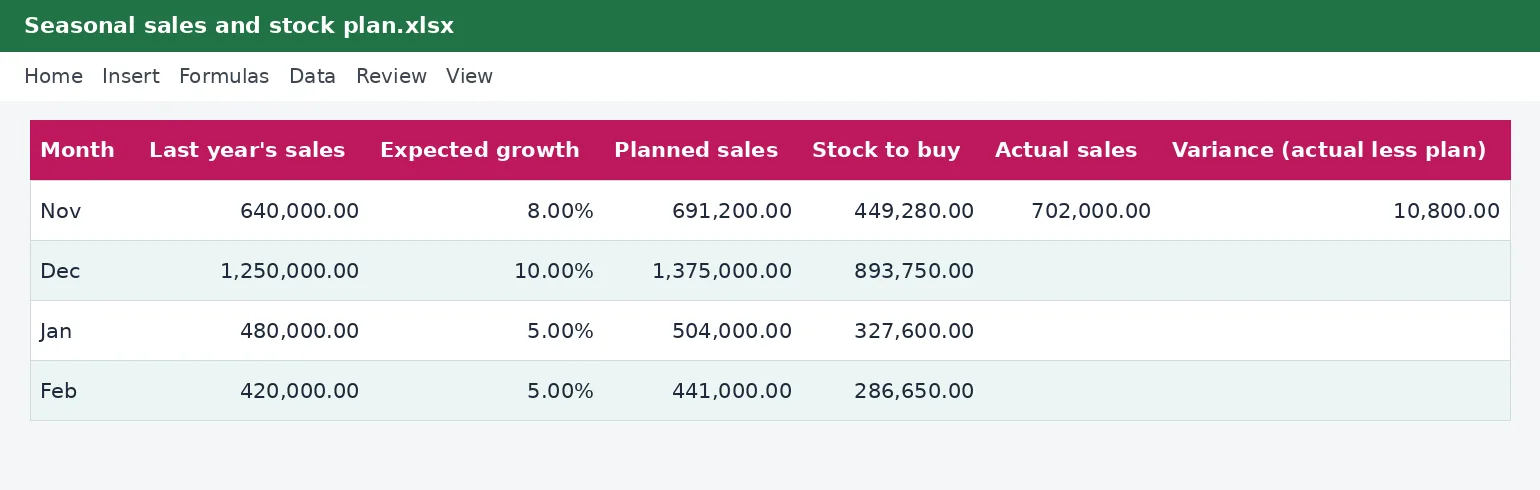
Seasons make some months far busier than others. Enter last year's sales and the growth you expect for each month, and the workbook plans this year's sales, the stock you should buy at your usual cost ratio and, once the month is over, the variance between actual and planned sales, so you can order ahead and avoid being caught short.
Retailers, farmers, caterers and other businesses with busy and quiet seasons, and managers preparing the annual budget.
What is included
- Planned sales from last year and expected growth
- Stock purchases planned from the cost ratio
- Actual sales and variance by month
- Totals for the year
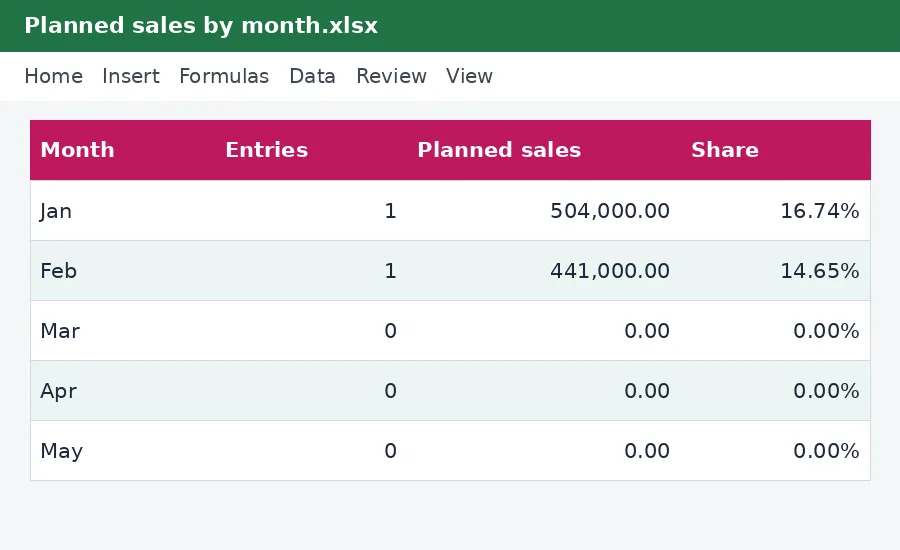
- Chart of planned sales by month
Advertisement
Screenshots
How to use it
- Type your usual cost of stock as a percentage of sales at the top.
- Enter last year's sales for each month and the growth you expect.
- Read the planned sales and the stock to buy for each month.
- Enter actual sales as the months pass and watch the variance.
Templates are tools to help with your own records. They are not tax or legal advice. Check the figures against official sources before filing or paying.
Advertisement
More in this category
-
 Businesspdf
Small business funding guide for Kenya
The main ways Kenyan small businesses raise money: savings, loans, SACCOs, mobile lenders, grants and investors.
KES 720KES 800-10%
View details →
-
 Businesspdf
SOP writing guide and templates
How to write standard operating procedures that people actually use, with templates for a process, a checklist and a training record.
KES 810KES 900-10%
View details →
-
 Businesspdf
Sales proposal and quotation pack
Win more work with a clear proposal, a professional quotation and a follow-up letter, with a checklist for each step.
KES 630KES 700-10%
View details →
What the seasonal sales and stock planner does
Seasons make some months far busier than others. Enter last year's sales and the growth you expect for each month, and the workbook plans this year's sales, the stock you should buy at your usual cost ratio and, once the month is over, the variance between actual and planned sales, so you can order ahead and avoid being caught short.
Who it is for
Retailers, farmers, caterers and other businesses with busy and quiet seasons, and managers preparing the annual budget.
How to use the workbook
- Type your usual cost of stock as a percentage of sales at the top.
- Enter last year's sales for each month and the growth you expect.
- Read the planned sales and the stock to buy for each month.
- Enter actual sales as the months pass and watch the variance.
- Save a copy under a new name for each month or year, so earlier records stay as they were.
What is inside
- Planned sales from last year and expected growth
- Stock purchases planned from the cost ratio
- Actual sales and variance by month
- Totals for the year
- Chart of planned sales by month
The workbook has these sheets: Instructions, Plan, By month. The main table has the columns Month; Last year's sales; Expected growth; Planned sales; Stock to buy; Actual sales; Variance (actual less plan). Yellow cells are for you to fill in and grey cells calculate by themselves, so leave the grey cells alone. The example rows show how it works; type over them with your own entries.
Tips for getting it right
- Use real figures from last year, not estimates.
- Order stock early for your busiest months.
- Update growth assumptions when conditions change.
- Compare the plan with your cash flow forecast.
Why keep this record
Running a business on memory works until it grows. Writing the numbers down turns opinions into facts you can compare month to month, and shows early which products, customers or costs deserve attention. Even a simple workbook, used every week, usually beats a sophisticated one that is opened once a year.
Questions people ask
Do I need to know Excel formulas? No. Type into the yellow cells and the rest is worked out for you. The formulas are visible if you want to see how a figure is reached.
Can I add rows or change the layout? You can add your own columns to the right and your own notes. If you insert rows inside a table, copy the grey formula cells down so the new rows calculate too.
Will it work on my phone or in Google Sheets? Yes for viewing and typing, but dropdown lists and the charts look best in desktop Excel or LibreOffice.
Keeping it safe and up to date
A plan is only as good as the numbers you put in. Start with honest estimates, update the workbook as real figures arrive, and compare the two so your next estimate is better. Save a dated copy each month so you can see how your thinking changed.
Read how to build a cash flow forecast for the wider picture. Free calculators that go with it: Turnover tax calculator. See more business templates or ask us for a custom one.
The workbook works in Microsoft Excel, LibreOffice and Google Sheets. It is a tool to help you work out and record figures, not tax, legal or accounting advice, and it is not affiliated with the Kenya Revenue Authority. If something does not work as described, contact us and we will put it right.
Related guides, calculators and templates
- Free calculator: Turnover Tax Calculator
- Guide: How to register for turnover tax and file monthly returns on iTax
- Guide: How to use M-Pesa statements to prove income and expenses
- Guide: Bookkeeping for small businesses in Kenya: how to get started
- Another template: 12-month cash flow forecast
- Another template: Break-even and pricing calculator
- Another template: Budget versus actual tracker
Need something different? Request a custom template, browse all guides or see every Excel template.
Scroll inside the box to read more.