Simple cashbook
Record money in and money out, keep a running balance and see a monthly summary.

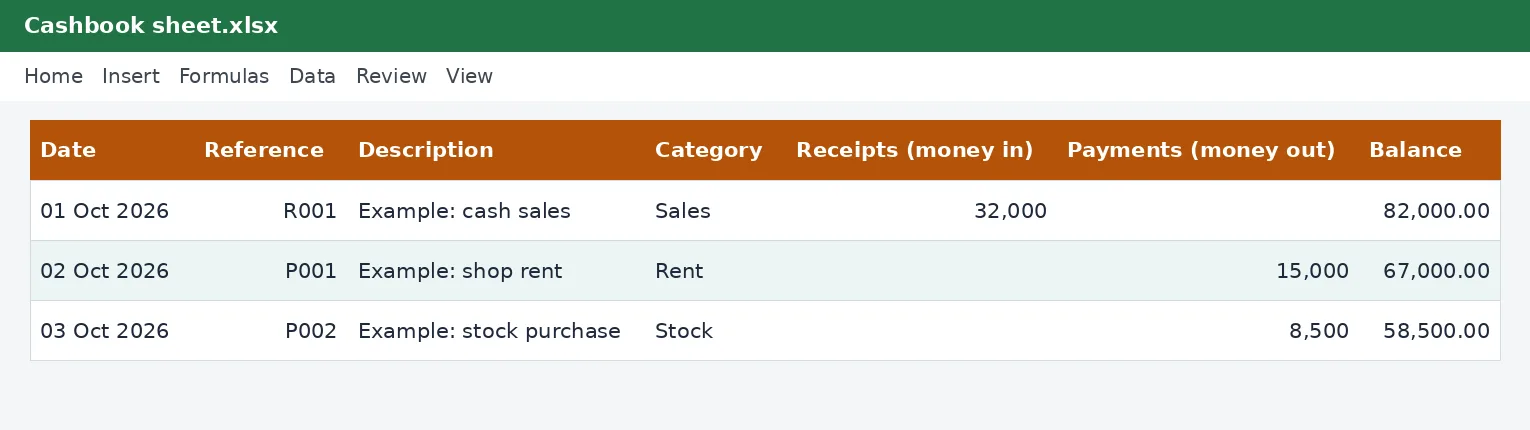
The simplest way to keep your business books. Type your opening balance, then one row per transaction. The balance updates on its own, and a monthly sheet totals your receipts and payments.
What is included
- Running balance
- Categories you can choose from a list
- Monthly receipts and payments
- Room for 500 transactions
Advertisement
Screenshots
How to use it
- Type your opening balance.
- Record each transaction.
- See the monthly summary.
Templates are tools to help with your own records. They are not tax or legal advice. Check the figures against official sources before filing or paying.
Advertisement
More in this category
-
 Accountingpdf
Credit control policy and collection letters
A credit policy and four collection letters, from a friendly reminder to a final demand, to get paid on time.
KES 810KES 900-10%
View details →
-
 Accountingpdf
Audit preparation guide for small businesses
How to prepare for an annual audit: documents, schedules, timeline and what the auditor will ask.
KES 900KES 1,000-10%
View details →
-
 Accountingpdf
Internal controls checklist for small businesses
A practical checklist of controls that protect a small business from error and fraud: cash, sales, purchases and payroll.
KES 720KES 800-10%
View details →
The simplest accounting record a small business can keep
Every business, however small, needs to know three things: how much money came in, how much went out, and how much is left. A cashbook answers all three. It is a plain list of every receipt and every payment in date order, with a running balance, and for many small traders it is the only accounting record they need. This free cashbook workbook gives you that list, with the balance worked out as you type and a monthly summary that shows where the money went.
What a cashbook is, and why it still works
A cashbook records real money movements: cash in the till, money received by M-Pesa, bank deposits, and payments made by any of those routes. Because it follows the money, it is easy to understand and easy to check against a bank or M-Pesa statement. You do not need to know double-entry bookkeeping to keep one. You only need the discipline to write down each transaction on the day it happens.
- Receipts are money coming in: sales, deposits from customers, loans, owner contributions.
- Payments are money going out: stock, rent, salaries, transport, taxes.
- Balance is what you should have, so you can compare it to what you actually have.
How to use the workbook
- Type your opening balance in the yellow cell at the top, the money you start with.
- For each transaction, fill one row: the date, a reference such as a receipt number, a short description, a category from the dropdown, and the amount in either the Receipts or the Payments column.
- Watch the Balance column. It updates after every row.
- Each week or month, compare the balance with your cash and your bank or M-Pesa statement. Any difference is a mistake or a missing entry to find and fix.
- On the Monthly sheet, choose the year and read the receipts, payments and net for each month.
The workbook has room for 500 transactions. When it is full, save the file, start a new copy and carry the closing balance forward as the next opening balance.
Why categories matter
The Category column lets you group transactions: sales, stock, rent, salaries, utilities, transport, tax and other. Once your cashbook has a few months of data you can filter or sort by category to see what you spend most on and what brings in the most. That is the start of real financial control, and it makes the end of the year much easier, when you have to put together figures for your tax return.
Cashbook and tax
Keeping records is not only good practice, it is a legal obligation. Businesses must keep records of their income and expenses, generally for at least five years, and the Kenya Revenue Authority can ask to see them. A cashbook with supporting receipts and invoices is the evidence behind the figures you declare. If you are on turnover tax, your monthly sales total comes straight from the receipts column, and our nil returns guide explains what to file in a month with no activity. If you are registered for VAT, a cashbook is a good companion to the VAT return working sheet and the VAT calculator.
Habits that keep a cashbook accurate
- Write entries on the day, not at the end of the month.
- Keep every receipt and invoice, and put its number in the Reference column.
- Record personal withdrawals as their own category, so business and personal money stay separate.
- Count the cash in the till at the end of each day or week and compare it with the balance.
- Back up the file regularly, to email or cloud storage.
When to move beyond a cashbook
A cashbook shows cash movements but not what customers owe you or what you owe suppliers. If you sell on credit, or buy on credit in large amounts, you will eventually want an accounting system that tracks receivables and payables, and an accountant will help you choose one. Until then, a cashbook kept faithfully is a strong foundation.
This workbook is a record-keeping aid and not accounting or tax advice. For official guidance on keeping records, see the Kenya Revenue Authority website, and speak to an accountant for anything beyond a simple business.
Related guides, calculators and templates
- Guide: How to keep business records for KRA: what to save and for how long
- Guide: Bank reconciliation step by step: match your books to your bank
- Guide: Fixed assets and capital allowances explained for small businesses
- Another template: Bank reconciliation statement
- Another template: Customer invoices and aged receivables tracker
- Another template: Expense tracker with VAT
Need something different? Request a custom template, browse all guides or see every Excel template.
Scroll inside the box to read more.