Start-up costs and funding calculator
Work out how much money you need before you open: one-off costs, working capital, a safety margin, and whether your funding covers it.

Most businesses that run out of money in the first year did not know how much they needed in the first place. List your one-off costs, estimate what it costs to run the business each month, choose how many months of cover you want, add a safety margin and compare the total with the funding you have lined up. The workbook tells you plainly whether there is a surplus or a gap.
What is included
- One-off start-up costs list
- Monthly running costs and months of cover
- Contingency percentage
- Funding sources and the gap or surplus
- Share of the need covered
Advertisement
Screenshots
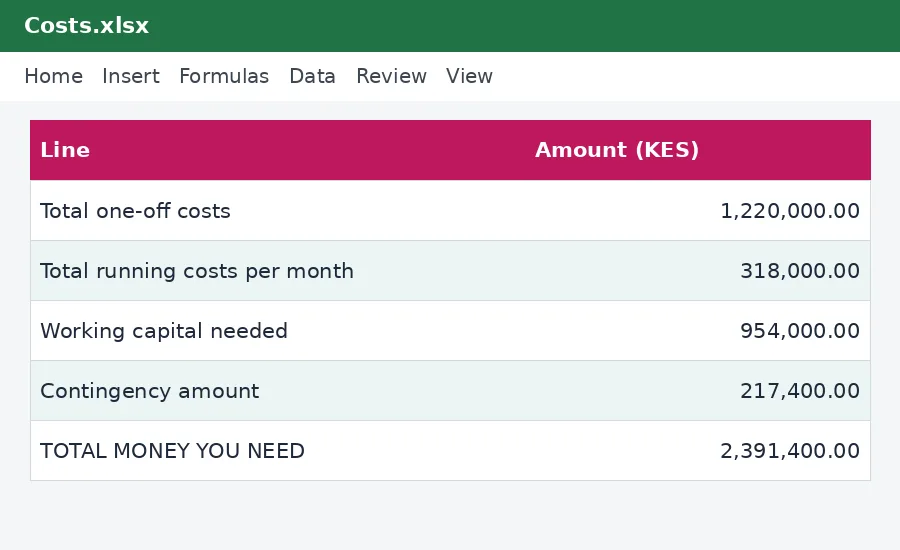
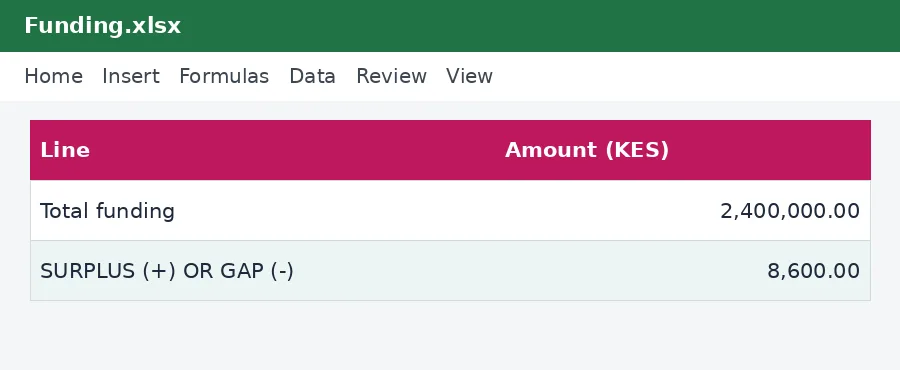
How to use it
- List your one-off costs.
- Enter monthly running costs and the months you want to cover.
- Set a contingency.
- Enter your funding and read the gap.
Templates are tools to help with your own records. They are not tax or legal advice. Check the figures against official sources before filing or paying.
Advertisement
More in this category
-
 Businesspdf
Small business funding guide for Kenya
The main ways Kenyan small businesses raise money: savings, loans, SACCOs, mobile lenders, grants and investors.
KES 720KES 800-10%
View details →
-
 Businesspdf
SOP writing guide and templates
How to write standard operating procedures that people actually use, with templates for a process, a checklist and a training record.
KES 810KES 900-10%
View details →
-
 Businesspdf
Sales proposal and quotation pack
Win more work with a clear proposal, a professional quotation and a follow-up letter, with a checklist for each step.
KES 630KES 700-10%
View details →
How much money do you really need to start?
The most common reason a new business fails is not a bad idea. It is running out of money before the idea has had time to work. Owners count the visible costs, such as the shop, the equipment and the first stock, and forget the invisible ones: the months of rent and salaries before customers arrive, the permits that cost more than expected, the repair that cannot wait. This workbook makes you list all of it, so that the number you take to the bank, to your family or to yourself is the real one.
The four parts of the answer
1. One-off costs
These are the things you pay once, to get going: registering the business and getting licences, legal and professional fees, deposits for premises and utilities, fit-out, equipment and furniture, computers and phones, a website and branding, opening stock, launch marketing and the first year's insurance. The workbook starts with a typical list and room for your own lines. Replace the example amounts with real quotes, and delete lines that do not apply.
2. Working capital
Working capital is the money that keeps the business alive until it pays for itself. Enter your monthly running costs: rent, salaries, utilities, marketing, transport, loan repayments and anything else that recurs. Then decide how many months of those costs you want to be able to cover with little or no income. Three months is a common minimum for a shop or a service. Six is safer for a business that sells slowly or seasonally. The workbook multiplies the two.
3. A safety margin
Whatever you estimate will be too low. Quotes rise, deliveries are late and sales take longer than hoped. A contingency of ten to twenty per cent of the one-off costs and the working capital is a sensible allowance, and the workbook adds it as a separate line so that you can see it.
4. Funding
List where the money will come from: your own savings, family and friends, a bank or Sacco loan, an investor, a grant or a competition prize. The workbook adds them up and compares the total with what you need. At the bottom it shows a surplus or a gap and says in plain words what the gap means.
What to do with a gap
- Cut or delay costs that are not essential to opening. Second-hand equipment, a smaller first order of stock and a simpler fit-out all reduce the need.
- Open in stages: start with one product or one location and expand when cash allows.
- Look for funding that is cheaper than a short-term loan, such as a supplier credit arrangement, a lease in place of a purchase or a customer deposit.
- Reduce the months of cover, but only if you have a credible plan for early sales.
- Be honest about whether the plan works at the size you can afford.
Do not forget tax and compliance
New businesses need to register and to understand what they will owe. Get a KRA PIN, which our guide to getting a KRA PIN explains, and register on iTax, using the steps in our iTax registration guide. Find out early whether you will have to register for VAT, which depends on your expected turnover, and decide how you will keep records: our cashbook and expense tracker templates make a good start. If you will employ people, add the employer's contributions to your running costs, which the staff cost budget in this collection helps with. Our VAT calculator is useful for pricing and for checking costs that include VAT.
Using the figure
The total is your funding target. Use it when you speak to a lender, and use the lines behind it to explain how you arrived at it. A banker is far more confident in a borrower who can say what each shilling is for. Keep the workbook, and when the business is running, compare what you actually spent with what you planned. That is how the next plan becomes more accurate than the first.
This workbook is a planning tool and not financial, legal or tax advice. The example amounts are illustrations only, and your costs will differ. For advice on business structure, licences and funding, speak to an accountant or a business adviser, and check tax matters with the Kenya Revenue Authority.
Related guides, calculators and templates
- Guide: How to build a 12-month cash flow forecast for a small business
- Guide: How to price your products and services: markup, margin and break-even
- Guide: Turnover tax for small businesses in Kenya: rate, limits and when to use it
- Another template: 12-month cash flow forecast
- Another template: Break-even and pricing calculator
- Another template: Budget versus actual tracker
Need something different? Request a custom template, browse all guides or see every Excel template.
Scroll inside the box to read more.