Weekly casual wages sheet
Record the days each casual worker worked, work out their wages and keep a signed record of payment.

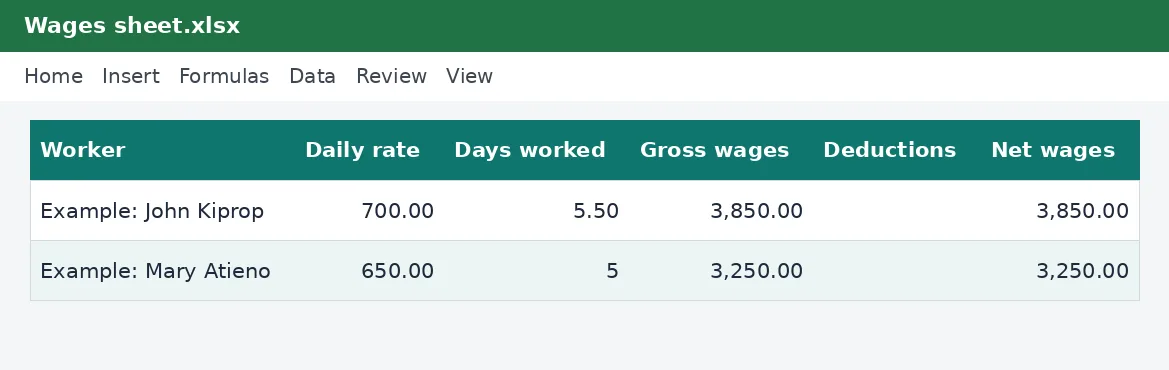
A simple weekly sheet for casual and daily-paid workers: daily rate, days worked Monday to Sunday, gross wages, deductions, net wages and a signature column. Print it each week as your payment record.
It works out wages only. Use the payroll workbook for anyone whose pay is taxable.
What is included
- Days worked Monday to Sunday, half days allowed
- Gross, deductions and net wages
- Signature column for each worker
- Weekly totals
Advertisement
Screenshots
How to use it
- Write the week-ending date.
- List workers with daily rates and days worked.
- Print, pay and have each worker sign.
Templates are tools to help with your own records. They are not tax or legal advice. Check the figures against official sources before filing or paying.
Advertisement
More in this category
-
 Payrollpdf
Payroll policy and procedures manual
A written payroll manual: roles, monthly timetable, calculations, approvals, payment, remittances and record keeping.
KES 1,080KES 1,200-10%
View details →
-
 Payrollpdf
Leave policy template for Kenyan employers
A complete leave policy covering annual, sick, maternity, paternity, compassionate and study leave, with how to apply.
KES 540KES 600-10%
View details →
-
 Payrollpdf
Termination and redundancy guide with letters
How to end employment lawfully in Kenya: notice, final dues, redundancy steps and the letters you will need.
KES 900KES 1,000-10%
View details →
A simple, honest record of casual wages
Farms, building sites, workshops, restaurants and households all rely on casual workers who are paid by the day. Because the pay is small and frequent, the paperwork is often skipped, and that is where problems begin: a worker says they were underpaid, a supervisor remembers a different number of days, or an inspector asks to see your records and there are none. This weekly wages sheet fixes that with one page per week that records who worked, how many days, what they earned, and a signature to show they were paid.
How the sheet works
At the top you write the week-ending date. Below that, each worker gets one row. You enter their daily rate and put a number in each day they worked: 1 for a full day, 0.5 for half a day, or leave it blank for a day off. The sheet adds up the days, multiplies by the daily rate to give gross wages, subtracts any deduction such as an advance you gave during the week, and shows net wages. A signature column at the end is for each worker to sign when they receive their money. Print the sheet, pay the workers and file it.
- Room for 40 workers on one sheet
- Half days and part-time shifts supported
- Gross wages, deductions and net wages worked out for you
- Weekly totals at the top, so you know how much cash to prepare
Why records matter, even for casual work
The Employment Act sets out what an employer must record and provide, including the payment of wages and the keeping of employment records. A signed weekly sheet is a simple way to show what was agreed and paid. It protects workers, because they can see how their pay was worked out, and it protects you, because you can prove that wages were paid and when. If a dispute ever reaches a labour officer or a court, a bundle of signed weekly sheets is far stronger than a verbal account.
When a casual worker becomes something more
Under the Employment Act a casual employee is someone engaged for a short period, paid at the end of each day, and not for longer than a set period at a time. If a casual worker is kept on continuously for an extended period, the law may treat their engagement as a different kind of contract, with the extra rights that come with it, such as notice and, in time, leave. If you find the same worker appearing on your sheet week after week for months, speak to an adviser about whether they should be on a proper contract and on your payroll.
What this sheet does not do
This sheet works out gross and net wages only. It does not calculate PAYE, NSSF, SHIF or the Housing Levy. For many genuinely casual workers earning small daily amounts, no PAYE will be due, because the pay falls below the point at which tax starts after personal relief of KES 2,400 a month. But that depends on the worker's total pay and other circumstances, and the other statutory deductions have their own rules. If a worker is regularly employed, or their earnings are high enough to be taxable, move them onto your payroll and use our employment return guide and the monthly payroll workbook instead. You can also test a worker's figures with the PAYE calculator.
Tips for running casual labour well
- Agree the daily rate and the working hours before the work starts, and write them on the sheet.
- Check the rate against the minimum wage that applies to the kind of work and the area.
- Fill in the days at the end of each day or each week, not from memory a month later.
- Pay on the day you promised and get the signature immediately.
- Keep the signed sheets together by month and keep them for at least five years.
- Record advances on the sheet as deductions, so the balance is clear.
Extra copies and totals
Save a new copy of the file for every week, or copy the Wages sheet inside the same workbook and name each sheet with the date. The total wages figure at the top gives you the amount of cash to withdraw before payday. If you want to compare costs across weeks, copy the totals into a simple list or into our records and returns routine.
This sheet is a record-keeping tool and not legal or tax advice. Minimum wages, overtime and your obligations vary with the sector and the contract, so check the current rules, for example with the Ministry of Labour or the Kenya Revenue Authority.
Related guides, calculators and templates
- Guide: How to run payroll for a small business in Kenya
- Guide: How PAYE is calculated in Kenya, step by step
- Guide: NSSF contributions explained: tiers, limits and what you pay
- Another template: Annual PAYE and payroll summary
- Another template: Annual leave planner and register
- Another template: Employee records register and contract tracker
Need something different? Request a custom template, browse all guides or see every Excel template.
Scroll inside the box to read more.