Monthly payroll workbook (up to 50 employees)
Enter your employees once and get PAYE, NSSF, SHIF, Housing Levy, net pay and total employer cost for every one of them, with printable payslips.

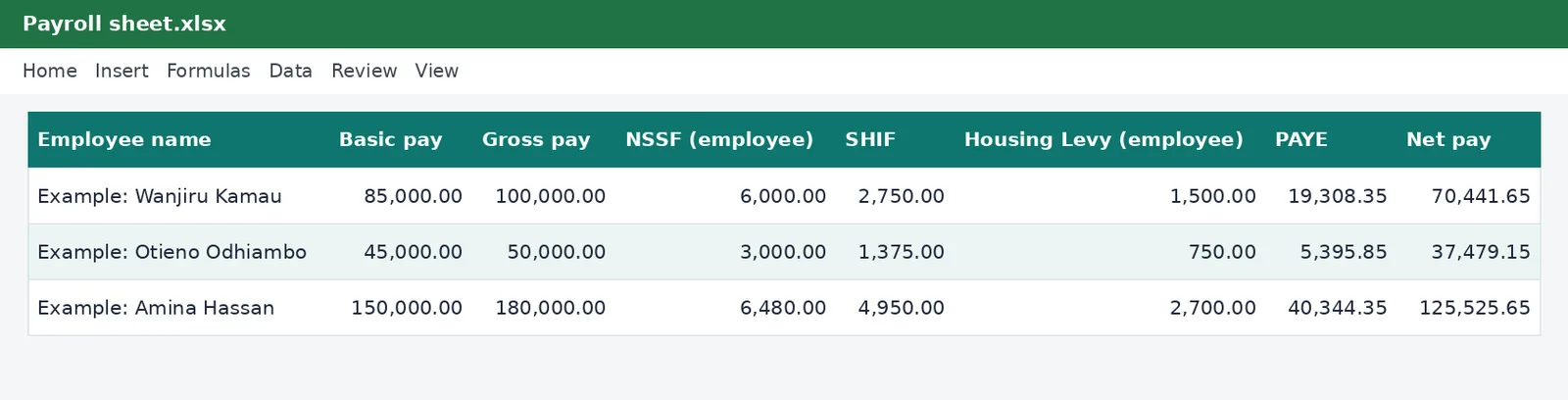
A complete monthly payroll in one Excel file. List up to 50 employees with their basic pay and allowances and the workbook works out every statutory deduction, each person's net pay, and what your payroll really costs you, including the employer's NSSF and Housing Levy.
Choose any employee on the Payslip sheet to print their payslip. Every rate sits on one Rates sheet, so when a rate changes you type it once.
The calculations follow the same rules as the KenyaTax PAYE, NSSF, SHIF and Housing Levy calculators, and agree with them to the cent.
What is included
- PAYE with bands, personal relief and insurance relief
- NSSF tier I and II, SHIF and Housing Levy, employee and employer
- Net pay and total cost to employer for each person
- Printable payslip for any employee
- All rates on one sheet you can update
Advertisement
Screenshots
How to use it
- Open the Rates sheet and check every figure against the official source for the month.
- On the Payroll sheet, type over the three example employees and add yours in the yellow cells.
- Read the totals at the top: they are what you pay to KRA, NSSF, SHA and the Housing Levy fund.
- Use the Payslip sheet to print each payslip.
Rates and thresholds
Edit the Rates sheet when a statutory rate changes.
Templates are tools to help with your own records. They are not tax or legal advice. Check the figures against official sources before filing or paying.
Advertisement
More in this category
-
 Payrollpdf
Payroll policy and procedures manual
A written payroll manual: roles, monthly timetable, calculations, approvals, payment, remittances and record keeping.
KES 1,080KES 1,200-10%
View details →
-
 Payrollpdf
Leave policy template for Kenyan employers
A complete leave policy covering annual, sick, maternity, paternity, compassionate and study leave, with how to apply.
KES 540KES 600-10%
View details →
-
 Payrollpdf
Termination and redundancy guide with letters
How to end employment lawfully in Kenya: notice, final dues, redundancy steps and the letters you will need.
KES 900KES 1,000-10%
View details →
Running payroll in Kenya with a spreadsheet you can trust
Every month an employer in Kenya has to turn each employee's pay into a set of figures that must be right: gross pay, the statutory deductions, the tax, the net pay that reaches the bank account, and the employer's own contributions on top. Getting one of those wrong means an unhappy employee, a penalty from the Kenya Revenue Authority, or a correction you have to make the following month. A monthly payroll workbook puts all of that in one place, with the working visible, so you can check it as well as rely on it.
This workbook handles up to 50 employees. You type each person's basic pay, allowances, insurance premiums and any other deductions in the yellow cells. Everything else calculates by itself, and a Payslip sheet prints a clear payslip for any employee you choose from the list.
What the workbook works out for every employee
- PAYE on taxable pay, using the monthly bands on the Rates sheet, after personal relief (currently KES 2,400 a month) and any insurance relief.
- NSSF in two tiers. Tier I is charged on pay up to the lower earnings limit of KES 9,000 and Tier II on pay between that and the upper limit of KES 108,000, at 6% each for the employee and the employer.
- SHIF, the Social Health Insurance Fund contribution, at 2.75% of gross pay with a monthly minimum.
- The Affordable Housing Levy, at 1.5% from the employee and the same from the employer.
- Net pay after all deductions, and total cost to employer, which adds the employer's NSSF and Housing Levy to gross pay.
How the calculation fits together
The order matters, which is why a spreadsheet that follows the rules is better than a quick mental sum. Gross pay is basic pay plus allowances. NSSF, SHIF and the employee's Housing Levy are worked out on gross pay. Under the current rules these contributions are deducted before tax, so taxable pay is gross pay less those deductions. PAYE is then calculated on taxable pay through the bands, and relief is taken off the tax, never off the pay. Net pay is gross pay less NSSF, SHIF, the Housing Levy, PAYE and anything else you deduct, such as a staff loan.
The formulas follow the same rules as the KenyaTax PAYE calculator, NSSF calculator, SHIF calculator and Housing Levy calculator, and the results agree with them to the cent. If you want to double-check one employee, run the same figures through the PAYE calculator and compare.
Keeping the rates current
Statutory rates change, usually through the Finance Act, and sometimes in the middle of a year. Every rate and threshold in this workbook lives on the Rates sheet, each in its own labelled cell. When something changes you type the new figure once and every employee recalculates. That is much safer than a workbook with the rates buried inside hundreds of formulas. Before you use the workbook each month, read down the Rates sheet and compare each value with the current official source.
A monthly routine that works
- Save a fresh copy of the workbook with the month in the file name.
- Check the Rates sheet against the latest official figures.
- Update each employee's pay, add new starters and remove leavers.
- Read the totals at the top of the Payroll sheet. They tell you what to pay KRA, NSSF, the Social Health Authority and the Housing Levy fund, and how much cash you need for salaries.
- Print or save the payslips and give each employee theirs.
- Keep the file. Tax records should be kept for at least five years.
Deadlines to put in your diary
PAYE and the other payroll remittances are generally due by the 9th day of the month after the one you are paying for. Late payment attracts penalties and interest, so it is worth setting a reminder for the first week of every month. Confirm the exact dates for each payment on the relevant authority's website, because they can change. At the end of the year you will also file the employer's annual return, and your employees will need their P9 forms. Our guide to filing your employment return with a P9 explains what employees do with them.
Who this workbook suits, and where to be careful
It suits small and medium employers with up to 50 staff who want accurate payslips and a clear monthly summary without buying payroll software. It is a calculation and record-keeping tool, not a filing system: you still file and pay through iTax and the other portals. If you have employees with benefits in kind, a company car, housing provided by the employer, or special tax status, check how those are taxed before you rely on the totals, and speak to a tax adviser where you are unsure.
The rates on the Rates sheet are copied from the KenyaTax rates table and, like everything on the site, they have not yet been verified by us for the period. Always confirm them against the Kenya Revenue Authority, NSSF, the Social Health Authority and the Finance Act before paying anyone. The official source for tax matters is the Kenya Revenue Authority website.
Related guides, calculators and templates
- Free calculator: PAYE Calculator
- Free calculator: NSSF Calculator
- Free calculator: SHIF Calculator
- Guide: NSSF contributions explained: tiers, limits and what you pay
- Guide: SHIF contributions explained: rate, minimum and who pays
- Guide: The Affordable Housing Levy explained for employees and employers
- Another template: Payslip generator
- Another template: Staff cost and headcount budget planner
- Another template: Annual PAYE and payroll summary
Need something different? Request a custom template, browse all guides or see every Excel template.
Scroll inside the box to read more.